
Antique iron beds have remained popular for well over a century, admired for their timeless beauty, remarkable craftsmanship, and ability to complement both traditional and contemporary interiors. However, not all antique iron beds were made to the same standards. Whether you’re an experienced collector or someone searching for the perfect vintage bed for your home, learning to identify the country of manufacture can tell you a great deal about the quality, durability, and long-term value of the bed.
The three largest producers of antique iron beds during the Victorian and Edwardian periods were Britain, France, and the United States. While each country developed its own distinctive styles, there were significant differences in the materials, manufacturing methods, and engineering that continue to influence how well these beds have survived over the last 100 to 150 years.
At CathouseBeds.com, we have restored and examined hundreds of antique iron beds over the years, and certain patterns become immediately apparent when comparing examples from each country.
American Antique Iron Beds: Built to Last
 If durability is the measure of quality, American-made antique iron beds stand comfortably at the top of the list.
During the late nineteenth and early twentieth centuries, America’s steel industry was booming. The mills of Pittsburgh, Pennsylvania, supplied exceptionally high-quality steel and iron that allowed manufacturers to build beds of outstanding strength. Companies invested heavily in machinery, foundry work, and engineering, resulting in products that were designed not only to be attractive but to withstand decades of daily use.
One of the easiest ways to identify an American iron bed is by its substantial construction. The tubing used is generally thick-walled and noticeably heavier than that found in European beds. Even after more than a century, many American beds remain perfectly straight, solid, and structurally sound.
The castings are another clear indicator. Rather than relying on lightweight decorative components, American manufacturers produced detailed cast iron ornaments by pouring molten iron into finely crafted moulds. These castings are deep, crisp, and exceptionally durable, often retaining their intricate detail despite many decades of wear.
Another hallmark of American beds is the quality of their joints and fittings. The connections between rails, posts, and decorative elements were engineered for strength, allowing many surviving examples to remain remarkably rigid today.
It is not uncommon to restore an American antique bed that requires little more than cleaning, refinishing, and replacement of worn fasteners before it is ready for another generation of use.
British Antique Iron Beds: Elegant but Often Less Robust
 British manufacturers produced some beautifully proportioned beds during the Victorian and Edwardian eras, and many display a distinctly understated elegance that continues to appeal to collectors.
However, from a structural perspective, British iron beds were generally built using lighter materials than their American counterparts.
Many British manufacturers utilised larger diameter seamed steel tubing rather than the heavier thick-wall tubing more commonly found in American production. While this gave the beds an attractive appearance, the thinner material could be more susceptible to dents, distortion, and corrosion over time.
The decorative castings, although often attractive, were generally less substantial and less finely detailed than those produced in America. British manufacturers frequently focused on producing beds that were elegant and economical rather than massively engineered.
Perhaps the most recognisable feature of many British beds is the extensive use of brass.
Brass top rails, brass tubing, finials, and decorative medallions became extremely fashionable during the late Victorian period. These bright polished accents created an impression of luxury and refinement.
Unfortunately, brass also introduced long-term structural compromises.
Because brass is considerably softer than iron or steel, decorative brass components can loosen over time. Brass collars and sleeves may split, decorative mounts can become detached, and mixed-metal construction sometimes contributes to movement within the frame after decades of use. Restorers frequently encounter missing brass trim or weakened joints where brass and steel meet.
This certainly does not mean British beds lack charm. Many remain beautiful pieces of furniture with tremendous decorative appeal. However, they generally require more careful restoration and maintenance than comparable American examples.
French Antique Iron Beds: Artistic Elegance Meets Practical Design
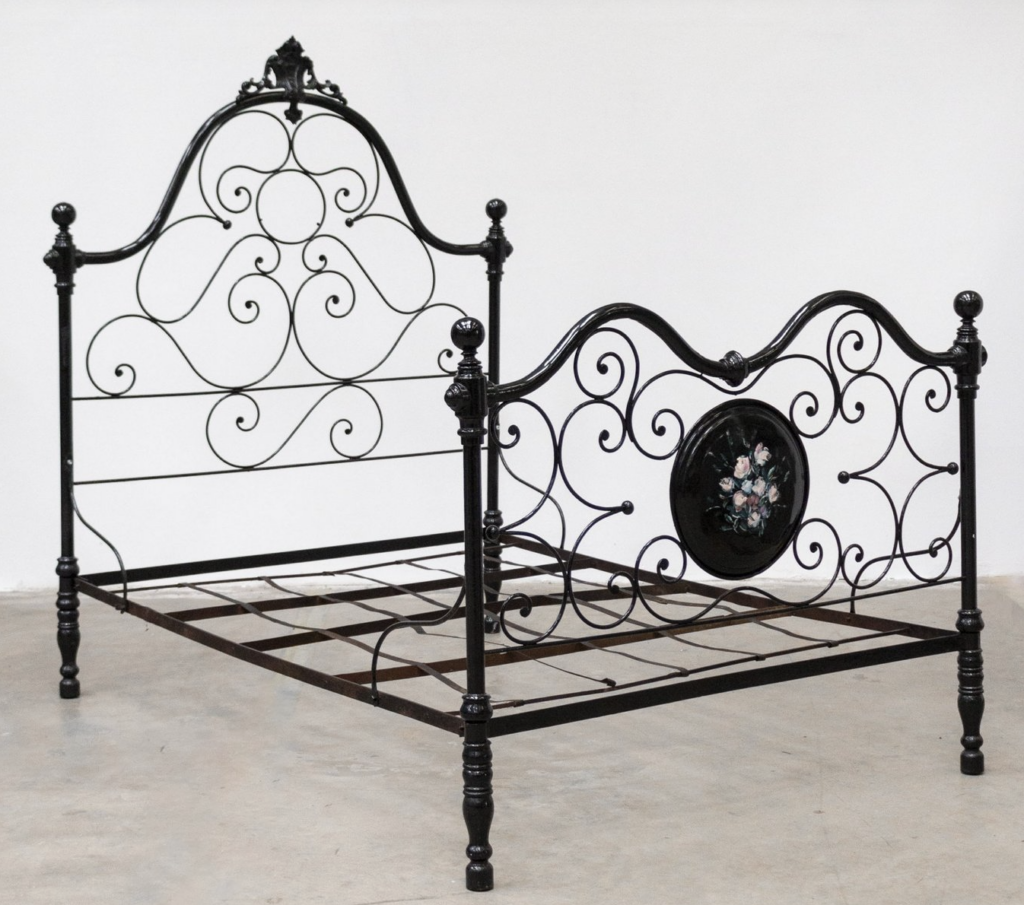 French antique iron beds occupy an interesting middle ground between British refinement and American engineering.
France embraced the flowing curves of the Art Nouveau movement more enthusiastically than almost any other country. Rather than relying on straight lines and restrained decoration, French designers celebrated movement, nature, and graceful asymmetry.
As a result, many French iron beds feature elegant scrolling headboards and footboards inspired by flowers, vines, leaves, and natural forms. These artistic curves make French beds instantly recognisable and highly sought after by interior designers looking to create a romantic or classic European aesthetic.
Structurally, French beds were generally better engineered than many British examples.
French manufacturers made comparatively little use of brass decoration, avoiding some of the structural weaknesses associated with mixed-metal construction. Their designs relied more heavily on wrought and formed iron, creating surprisingly rigid frames despite their graceful appearance.
Nevertheless, the tubing and steel used in France were still generally lighter than the heavy industrial materials available in the United States. While French beds have survived remarkably well overall, they rarely possess the sheer weight and robustness of comparable American beds.
Many French beds remain exceptionally serviceable today, particularly when professionally restored and fitted with modern support systems.
Looking Beyond Decoration
Many people naturally judge an antique bed by its appearance, but experienced restorers know that the real story lies beneath the paint.
The thickness of the tubing, the quality of the castings, the engineering of the joints, and the overall rigidity of the frame all reveal far more about a bed’s quality than decorative details alone.
Two beds may appear almost identical at first glance, yet one may weigh significantly more because of the superior materials hidden beneath its finish.
Weight is often one of the first clues. American beds frequently surprise owners with just how heavy they are. This extra weight is not accidental—it reflects the substantial wall thickness of the steel tubing and the solid cast iron components used throughout the frame.
Why So Many American Beds Have Survived
One question often asked by collectors is why American antique iron beds seem to survive in better condition than many European examples.
The answer lies largely in manufacturing philosophy.
American manufacturers were competing in a rapidly expanding domestic market where durability was an important selling point. Beds were expected to last for generations, and manufacturers built them accordingly.
Heavy tubing resisted bending.
Substantial castings resisted cracking.
Strong rail connections reduced movement.
Superior steel resisted fatigue.
When combined, these features produced beds that could withstand daily family use for well over a century.
Many American beds arriving in restoration workshops today remain remarkably straight and structurally sound despite their age.
Choosing the Right Antique Iron Bed Today
Every antique bed has its own story, and beauty is ultimately a matter of personal taste.
If your priority is artistic elegance with graceful flowing lines, a French Art Nouveau bed may be the perfect choice.
If you appreciate classic Victorian styling with polished brass details, a British bed offers timeless charm.
However, if long-term durability, structural integrity, and engineering excellence are your primary concerns, American-made antique iron beds remain difficult to surpass. Their
exceptional materials, robust construction, and superior foundry work have allowed many to survive in outstanding condition more than one hundred years after they were built.
For collectors, restorers, and families hoping to enjoy an antique bed every night—not simply admire it—this enduring strength continues to make American iron beds among the finest examples of period furniture ever produced.
At CathouseBeds.com, we believe every antique bed deserves careful restoration and another lifetime of use. Understanding where your bed was made is one of the first steps in appreciating the craftsmanship, history, and remarkable engineering behind these enduring pieces of furniture.