
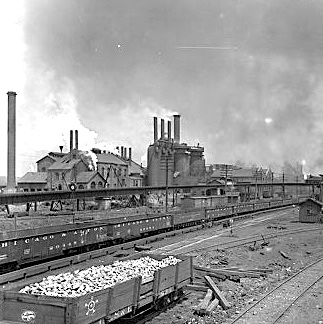
When you look at an antique iron bed today, it is easy to forget just how revolutionary the idea of an iron bed actually was in the 1800s.
For centuries, beds had traditionally been made from wood. Wood was readily available, familiar to craftsmen and relatively easy to work with. Iron, on the other hand, was heavy, difficult to shape and required specialized equipment and knowledge.
So when did Americans begin making iron beds—and where did that manufacturing actually begin?
The answer isn’t quite as simple as saying “Pittsburgh.”
Pittsburgh became enormously important to the American iron-bed industry, and Chicago eventually became another major center. But American experimentation with metal bedsteads began earlier and in more places than many people realize. What happened in Pittsburgh and Chicago during the second half of the 19th century, however, helped transform the iron bed from an unusual piece of furniture into one of the most popular household furnishings of the Victorian era.
Iron Beds Arrived Before the Big American Foundries
Metal bedsteads were already being developed in Europe during the first half of the 19th century. British manufacturers were experimenting with iron bedsteads in the 1840s, and by the middle of the century metallic beds were becoming increasingly familiar.
America was not far behind.
There is evidence of American patents involving bedsteads as early as 1840, followed by additional patents dealing with bedstead construction and metal components during the 1850s. A patent issued in 1850, for example, dealt specifically with an improved fastening system for bedsteads. By 1853, Scientific American was describing a bedstead design that used cast-iron clamps to connect the rails and posts.
This is important because it tells us something about the early American iron-bed industry.
It did not suddenly appear one morning when a giant factory opened its doors.
Instead, the technology developed gradually. Blacksmiths, metalworkers, hardware manufacturers and small foundries were experimenting with ways to make bedsteads stronger, more practical and easier to manufacture.
And that brings us to Pittsburgh.
Why Pittsburgh Became So Important
 During the 19th century, Pittsburgh was becoming America’s great iron and steel center.
Its location was extraordinarily important. The region had access to coal, transportation networks and the growing iron and steel industry that supplied raw materials to manufacturers throughout the country.
For a small foundry producing iron beds, being close to the source of its materials was a tremendous advantage.
Remember that transportation in the 1800s was nothing like it is today.
Moving heavy quantities of iron, steel, tubing and other materials was expensive. A small, independently owned foundry didn’t necessarily have the financial resources to purchase and warehouse enormous quantities of raw material. It made far more economic sense to locate within reasonable proximity to the mills and buy materials as they were needed.
This helps explain the concentration of small foundries in and around western Pennsylvania and nearby communities.
Pittsburgh wasn’t necessarily the birthplace of every American iron bed. Rather, it became one of the most important centers from which the American iron-bed industry grew.
That distinction is important.
The Small Foundry Was the Heart of the Industry
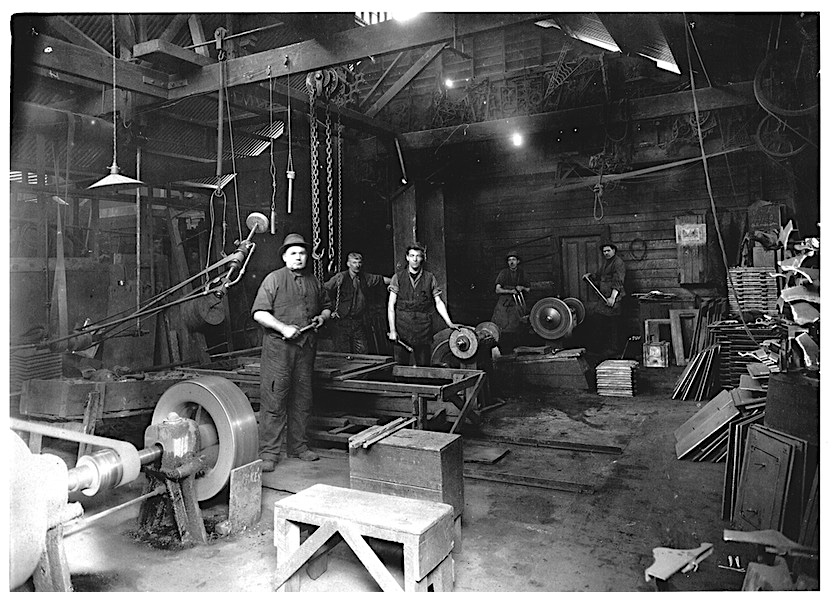
 One of the most fascinating things about 19th-century American iron beds is that many were not produced by enormous furniture factories.
They came from relatively small foundries.
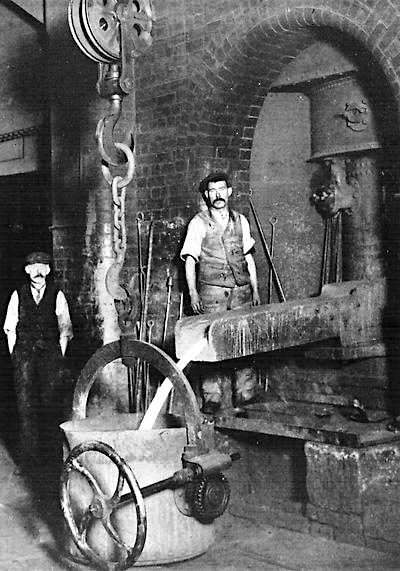
Some operations employed only a handful of people. A craftsman might specialize in creating patterns or molds, another might handle the molten iron, while others worked on cleaning, finishing and assembling the components.
The decorative castings were particularly demanding.
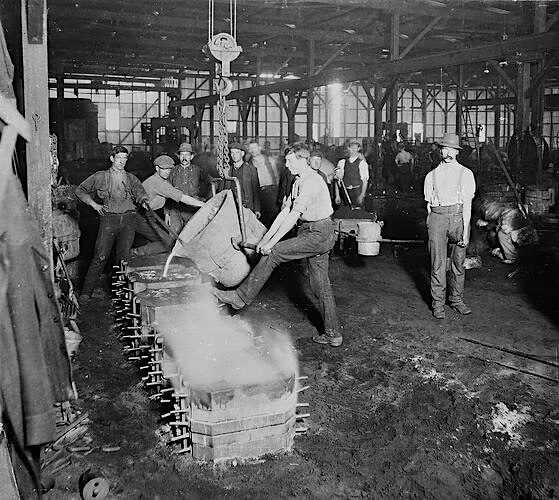
Molten iron had to be poured into carefully prepared sand molds to create the intricate flowers, leaves, scrolls, horseshoes, crosses, animals and other motifs that we associate with antique iron beds.
And this is where the craftsmanship becomes especially impressive.
A poorly designed or poorly prepared mold could produce a casting with weak details, imperfections or incomplete areas. A beautifully prepared mold could reproduce extraordinarily delicate ornamentation.
The casting was not merely decoration.
On many antique iron beds, those castings were an integral part of the structure.
That is one reason the quality of the foundry’s pattern makers and mold makers mattered so much.
Why So Many Different Beds Exist
There is another fascinating consequence of this small-foundry system.
It helps explain why collectors can encounter so many different antique iron-bed designs.
If one enormous manufacturer had produced virtually every bed in America, we would expect to see thousands upon thousands of identical frames.
But that wasn’t necessarily the case.
Small foundries could develop their own designs and serve their own local and regional markets. A successful pattern might be reused, modified or combined with another design. A customer might request something slightly different.
The result was an extraordinary variety of beds.
This is one of the things I find most fascinating about antique iron beds after decades of buying, selling and restoring them.
You can see a bed that looks familiar—and then discover a casting, panel, rail connection or decorative detail that you’ve never seen before.
That individuality is part of what makes an authentic antique iron bed so different from a reproduction.
Then Chicago Entered the Picture
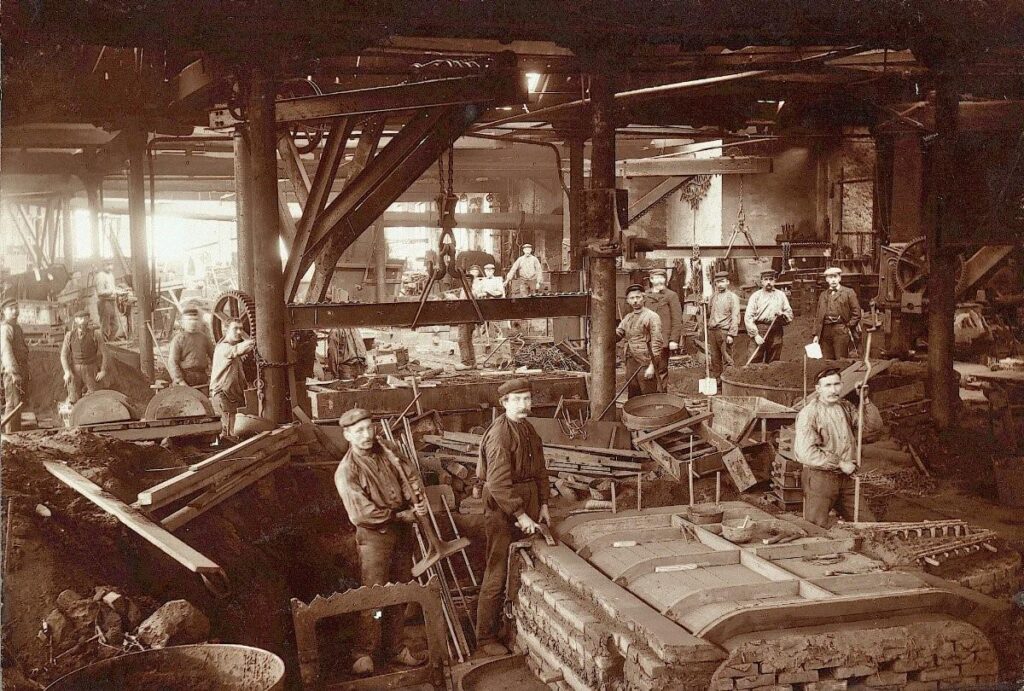 If Pittsburgh was one of the great early centers of American iron production, Chicago eventually became its great western counterpart.
Chicago’s rise was tied directly to geography.
The city was ideally positioned to receive iron ore from the Lake Superior region through the Great Lakes. During the 19th century, Chicago developed a substantial iron and steel industry, and several important rolling mills and steel-producing operations were established in the area.
Chicago already had several iron foundries by the early 1850s. In 1857, Eber B. Ward established the North Chicago Rolling Mill, and additional major mills followed during the following decades. By the 1880s, Chicago-area steel production had become enormous.
That industrial growth naturally created opportunities for manufacturers of all kinds of metal products—including iron beds.
An especially interesting historical source from Chicago lists an iron bedstead manufactory among the city’s iron-related businesses. That is significant evidence that iron-bed production had become an established part of Chicago’s manufacturing economy rather than merely an occasional sideline.
By the late 19th and early 20th centuries, Chicago had become one of the most important centers for American iron-bed manufacturing.
Pittsburgh and Chicago Had Different Advantages
The two cities developed their iron industries for somewhat different geographical reasons.
Pittsburgh benefited enormously from its access to coal and its established iron and steel infrastructure.
Chicago benefited from its position on the Great Lakes and its access to iron ore coming from Minnesota and Michigan.
Transportation was everything.
As railroads expanded and Great Lakes shipping became increasingly efficient, Chicago’s ability to obtain raw materials improved dramatically.
This allowed Chicago manufacturers to compete with eastern producers and eventually become a major center for metal furniture and iron beds.
The Chicago steel industry grew so rapidly that by the late 19th century several major mills were consolidated into the Illinois Steel Company. In 1901, Illinois Steel became part of U.S. Steel.
That industrial infrastructure provided exactly the kind of environment in which iron-bed manufacturers could flourish.
The Victorian Era Was the Golden Age

By the second half of the 19th century, the American iron bed had really come into its own.
The Victorian fascination with elaborate decoration was perfectly suited to cast iron.
Instead of simply being a practical substitute for a wooden bed, iron could be transformed into something highly decorative.
Foundries could create elaborate castings featuring flowers, leaves, scrolls, angels, horseshoes, butterflies, animals and geometric patterns.
And those designs could then be combined with iron tubing, brass fittings and painted finishes.
The bed became both furniture and sculpture.
This is also when regional differences become particularly interesting.
Pittsburgh-area and other eastern foundries produced remarkable beds, while Chicago and surrounding manufacturers developed their own distinctive styles. Some manufacturers eventually became larger and more recognizable names, while many smaller foundries disappeared without leaving much documentation behind.
In fact, many of the beds we encounter today may never be positively identified by manufacturer.
That doesn’t make them less interesting.
In some ways, it makes them even more interesting.
The Rise of Chicago’s Decorative Iron Beds
Chicago became particularly interesting as the century progressed because manufacturers were no longer simply trying to make iron beds practical.
They were trying to make them beautiful.
Companies such as the Art Bed Co. became associated with highly decorative Chicago-made iron beds, including examples incorporating painted panels, floral decoration, stenciling and other ornamental treatments.
Chicago’s enormous industrial base gave these manufacturers access to the materials and skilled labor necessary to produce increasingly sophisticated beds.
And this is one reason I have always believed that the Chicago area deserves much more recognition in the history of American antique iron beds.
When people think about 19th-century American iron, they naturally think of Pittsburgh.
They should.
But Chicago belongs in the conversation as well.
So When Did American Iron-Bed Production Really Begin?
If I had to put the history into a simple timeline, I would describe it this way:
1840s: American inventors and craftsmen were already experimenting with improved bedstead construction, while European manufacturers were developing commercially successful metal bedsteads.
1850s: American patents and documented experimentation with bedstead hardware and cast-iron components demonstrate that metal-bed construction was becoming an established technology. Chicago already had several iron foundries by the beginning of this decade.
1860s–1870s: The American iron and steel industries expanded rapidly. Small foundries in regions surrounding Pittsburgh, Wheeling and other industrial centers increasingly had access to the materials necessary to manufacture iron beds.
1880s–1900: This was the great expansion of the American iron-bed industry. Pittsburgh remained enormously important, while Chicago developed into a major center of iron and steel production and metal-bed manufacturing.
Early 1900s: Manufacturing became increasingly mechanized and consolidated. Larger companies began producing beds in greater quantities, while many of the small independent foundries gradually disappeared.
World War I: The traditional era of the beautifully handcrafted antique iron bed was coming to an end as industrial priorities, material requirements and manufacturing methods changed.
The Part of the Story I Find Most Fascinating
After working with antique iron beds for decades, what impresses me most isn’t simply the age of these beds.
It’s the amount of work that went into making them.
Imagine being a craftsman in the 1800s and being asked to create an ornate headboard.
There were no computerized drawings.
No CNC machines.
No modern foundry equipment.
A design had to be conceived, a pattern created, a mold prepared and molten iron poured correctly. The casting then had to be cleaned, fitted and incorporated into the finished frame.
And when you look closely at a truly exceptional antique iron bed, you can still see the evidence of that craftsmanship.
The crispness of a casting.
The depth of a floral design.
The way two pieces fit together.
The thickness of the tubing.
The quality of the brass.
The little details that a modern reproduction often struggles to duplicate.
Pittsburgh May Have Been the Heart—but America Was the Story
 So, where did American iron beds start being made?
The most accurate answer is that there wasn’t one single birthplace.
American metal-bed development was underway by the middle of the 19th century, with experimentation and manufacturing occurring in several regions.
But Pittsburgh became one of the most important centers because of its extraordinary iron and steel industry and its access to the raw materials that small foundries needed.
Chicago eventually became another major center because its location gave manufacturers access to Great Lakes iron ore and an expanding regional steel industry.
Together, these industrial regions helped create the conditions that allowed American iron beds to become some of the finest and most distinctive examples of 19th-century metal furniture.
And that may be the real story.
The antique iron bed sitting in an American home today isn’t simply an old piece of furniture.
It is a surviving example of America’s Industrial Revolution.
It represents the mills, the foundries, the pattern makers, the mold makers, the men who poured the molten iron, the craftsmen who assembled the frames—and the rapidly developing transportation network that made it possible to move these remarkable pieces of furniture across a growing country.
That is why, after all these years, I still find an original American antique iron bed so fascinating.
It isn’t just a bed.
It is a piece of American industrial history that happened to become furniture.