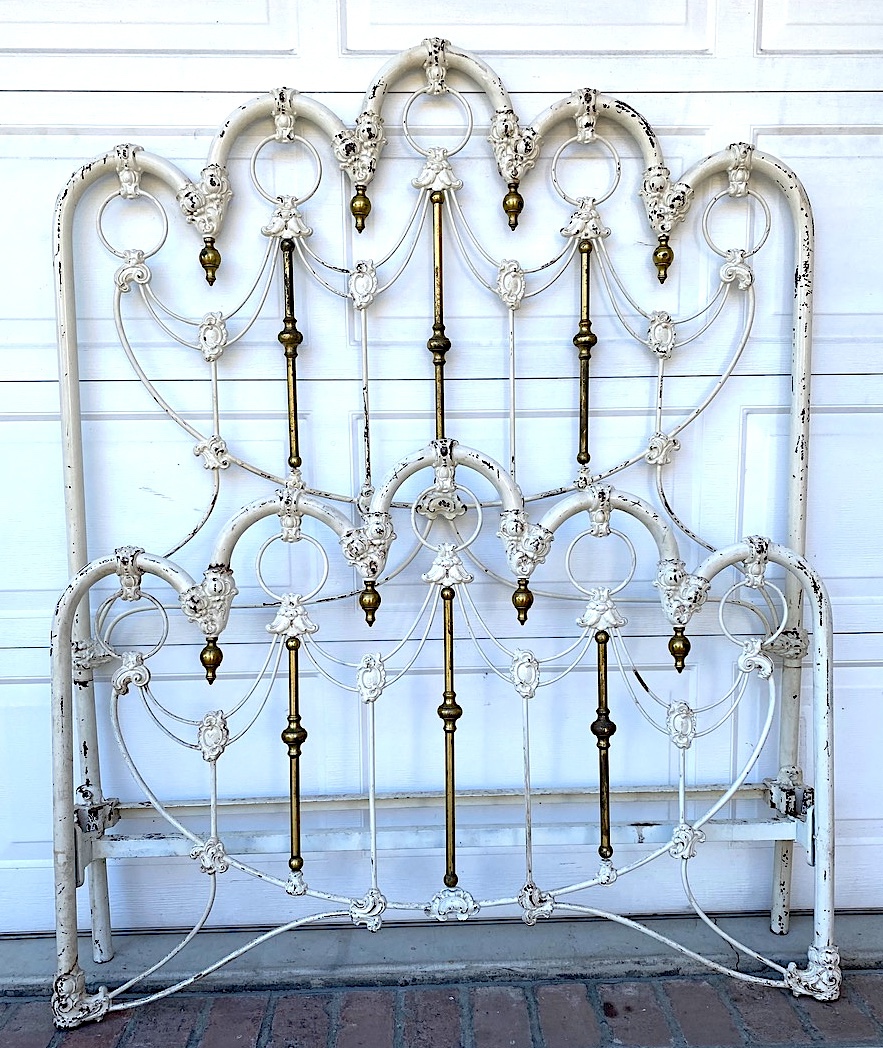
When most people see an antique iron bed decorated with gleaming brass finials, brass rods, brass collars or elaborate brass scrollwork, they naturally assume the brass was simply another decorative element in the design.
And certainly, it was decorative.
But after more than 50 years of buying, selling and restoring antique iron beds, I’ve come to believe there was considerably more behind the marriage of iron and brass than decoration alone.
Brass may have been one of the smartest marketing tools the early iron-bed industry ever employed.
To understand why, we have to go back to a time when the iron bed wasn’t yet the familiar American bedroom fixture it would eventually become.
It was the challenger.
And brass was already glamorous.
Before Antique Iron Beds, Brass Had the Prestige
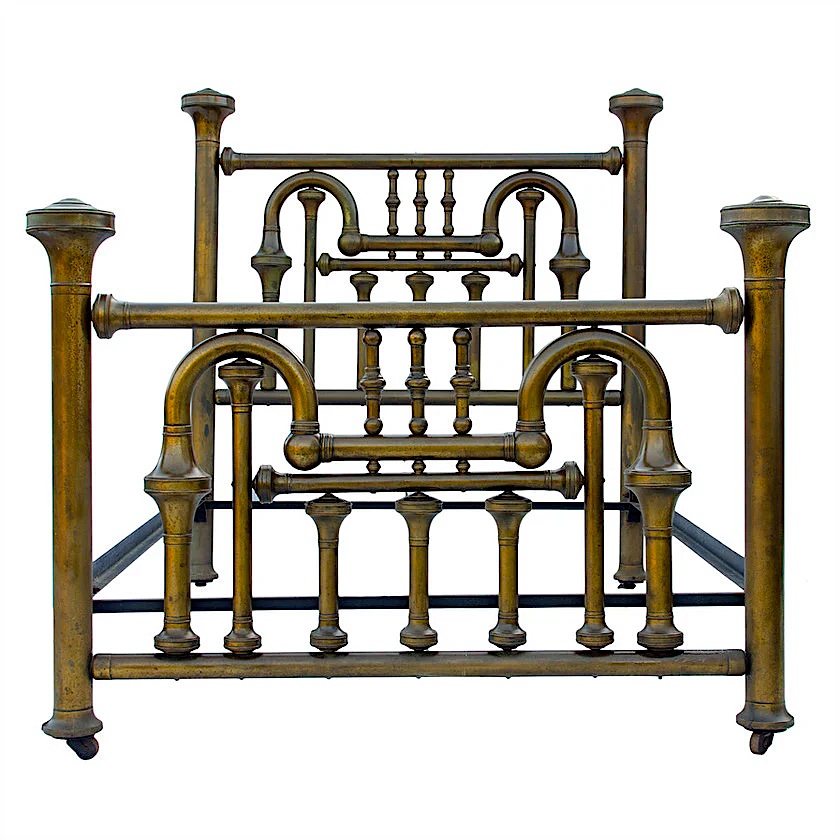 Metal bedsteads were becoming increasingly important during the 19th century. By the time of London’s Great Exhibition of 1851, elaborate brass bedsteads were important enough to be displayed as showpieces. R.W. Winfield, for example, exhibited an elaborate Renaissance-style brass bedstead there. Manufacturers such as Peyton & Peyton would subsequently become major producers of both brass and iron beds.
Brass had obvious visual appeal.
It gleamed.
It reflected light.
It looked expensive.
In a Victorian room filled with patterned wallpaper, elaborate textiles, decorative furniture and ornamentation, polished brass made a statement.
Iron had different advantages—but those advantages weren’t necessarily apparent from across a furniture showroom.
So imagine the problem facing an iron-bed manufacturer.
You have developed a bed that can be exceptionally strong, practical, sanitary and durable.
But sitting across the showroom is a polished brass bed that catches the customer’s eye before your salesman has said a word.
How do you compete with that?
One answer was ingenious:
Give the iron bed some of brass’s glamour without giving up the advantages of iron.
A Little Brass Could Change the Entire Appearance of an Iron Bed
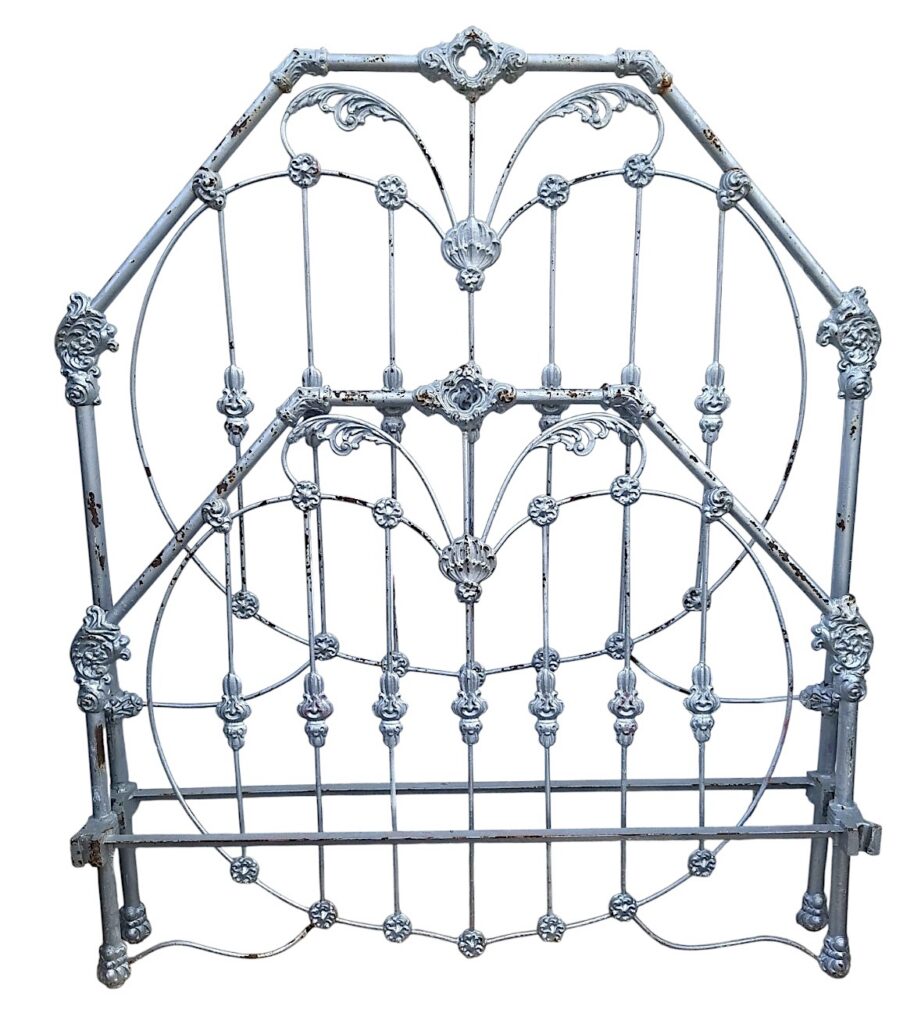
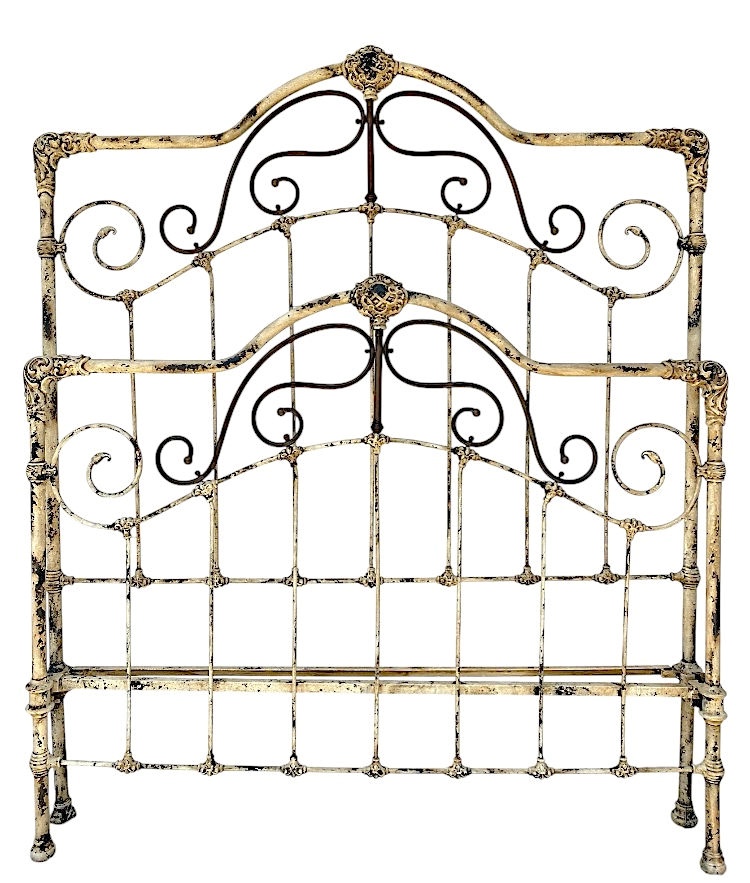 Look closely at surviving antique iron beds and you’ll find countless variations on the idea.
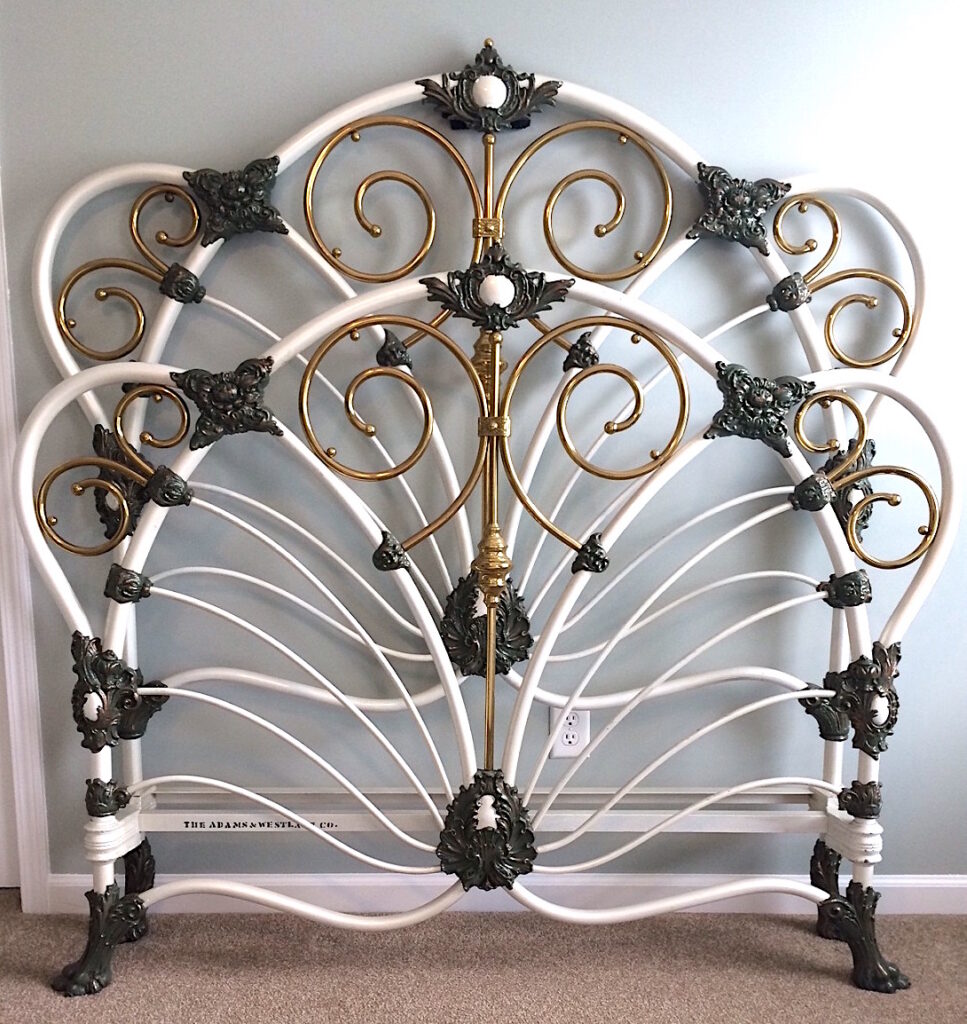
Brass finials could be placed on top of the posts.
Small brass spokes could be incorporated into an otherwise iron design.
Brass collars could punctuate vertical rods.
Scrolled brass elements could be introduced into the headboard and footboard.
Some beds used relatively little brass. Others incorporated enough that the contrast between painted iron and polished metal became one of the dominant elements of the design.
The manufacturer didn’t have to build the entire bed from brass.
He only had to put the brass where your eye would notice it.
That is what makes the concept so interesting from a marketing standpoint.
The customer could have the visual sparkle associated with a fashionable brass bed while purchasing a bed whose basic construction relied on iron.
Period catalogs confirm that the two materials increasingly occupied the same marketplace. By around 1910, for example, the Anchor Bedding Company was publishing an entire catalog devoted to “Brass and Iron Bedsteads.”
The distinction wasn’t necessarily brass or iron anymore.
Manufacturers had learned how successfully the two could coexist.
But Iron Had a Structural Story to Tell
 Appearance might get someone to stop and look at a bed.
Construction could help close the sale.
And this is where antique iron beds had an extraordinary story.
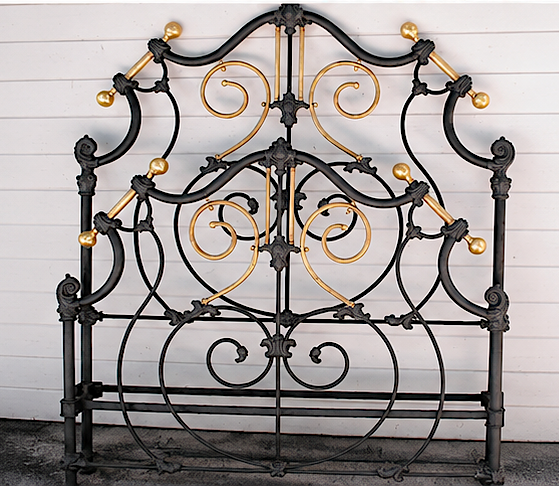
On many of the American antique iron beds we have handled at Cathouse, the decorative rods and tubing weren’t simply held together with a collection of small threaded decorative fasteners.
Cast-iron connecting pieces—what we commonly refer to in the trade as castings or “chills”—could lock the design together at critical junctions.
Molten iron was poured into molds positioned around connecting elements. Once cooled, those junctions became rigid parts of the structure.
There was nothing there that needed to be periodically screwed tighter.
And when you handle these beds 125 or 150 years later, you begin to appreciate what those craftsmen accomplished.
Many remain astonishingly solid.
They weren’t building them with the expectation that someone in 2026 would still be sleeping on them.
Yet here we are.
The Weakness of Threaded Connections
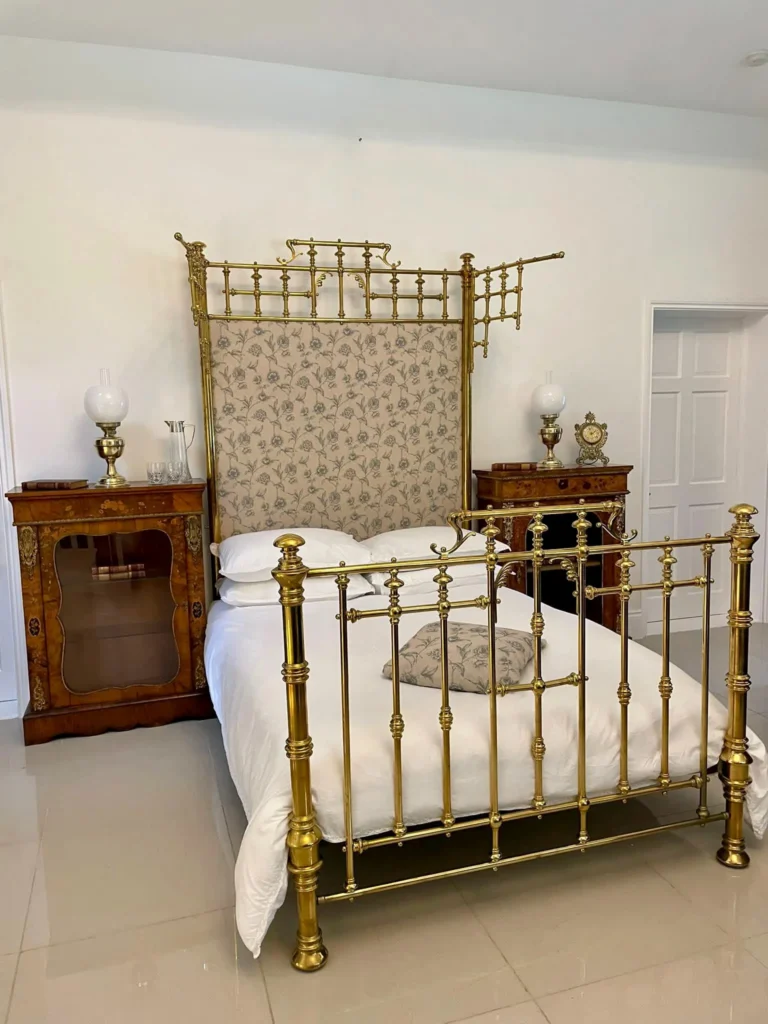 Traditional brass-bed construction presented a different challenge.
Brass bedsteads frequently incorporated tubes, fittings, threaded components and decorative connectors. Even period descriptions of early metal bedsteads complained about beds assembled with numerous screws and bolts becoming awkward and shaky. Manufacturers continually improved their construction as the industry developed.
The problem is basic mechanics.
Where two components can move against one another, repeated movement can eventually loosen a threaded connection.
A little movement becomes more movement.
The bed begins to wobble.
And unless those connections are tightened, movement creates another problem:
noise.
Anyone who has encountered an old brass bed with loose fittings knows exactly what I’m talking about.
Move in the bed and the bed answers back.
An iron bed with rigid cast connections doesn’t have the same number of small decorative threaded joints capable of gradually working themselves loose.
That was a very marketable difference.
And Then There Was the Noise Factor
You can imagine the Victorian salesman having some fun with this one.
A beautiful brass bed might look impressive in the showroom.
But what happens after years of use when its connections loosen?
Squeak.
Creak.
Rattle.
Now consider the alternative being offered across the aisle.
A substantial iron bed whose principal decorative structure had been permanently secured.
Suddenly the less glamorous material begins sounding awfully attractive.
And adding brass ornamentation allowed iron-bed manufacturers to make an even stronger proposition:
Why choose between beauty and practicality when you can have both?
You could have brass where you wanted to see it—and iron where you needed strength.
Iron Also Opened an Extraordinary World of Design
 There was another advantage that becomes obvious when you study large numbers of surviving antique beds.
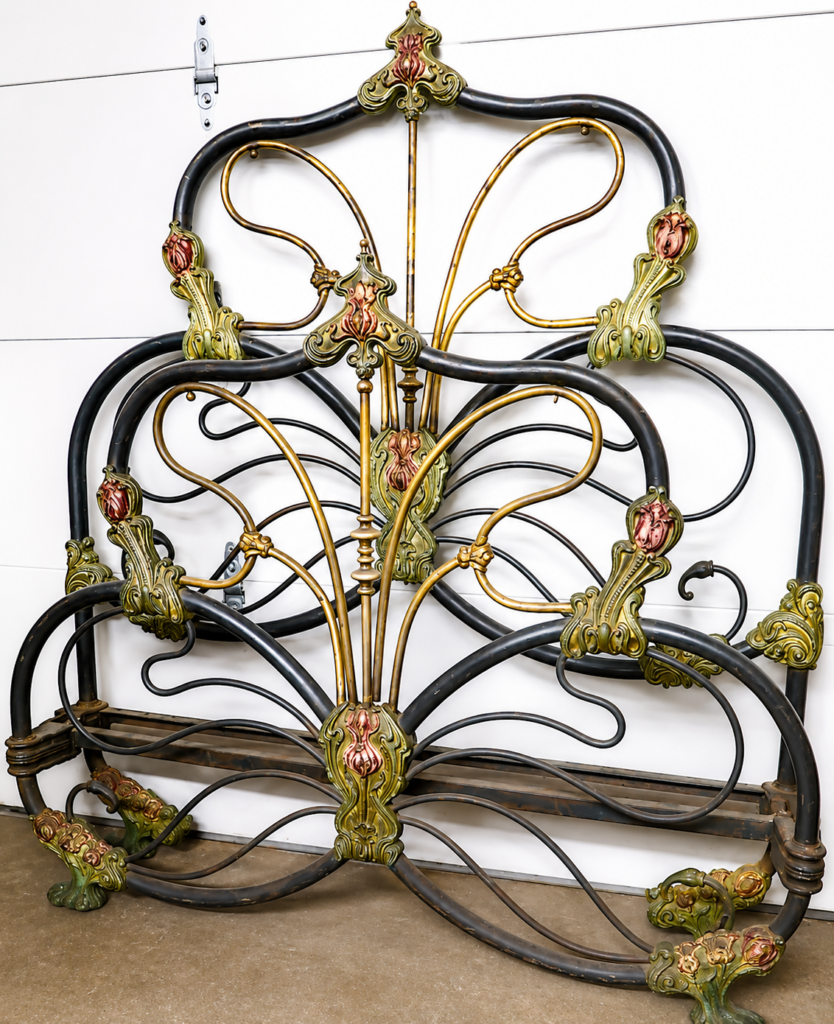
Iron offered manufacturers an enormous decorative vocabulary.
Tubing could be bent into sweeping curves.
Solid rods could be arranged into geometric patterns.
Castings could introduce flowers, leaves, ribbons, scrolls, crowns and countless other motifs.
Large open “see-through” castings could become the centerpiece of an entire headboard.
Paint added another dimension.
Beds could be black, white, cream, green, blue, red or virtually anything a manufacturer believed the market would accept. Period evidence shows iron beds being offered in combinations such as green and gold and maroon and gold.
Then brass could be added selectively.
That’s an extraordinary decorating toolbox.
And it meant an iron bed didn’t have to look industrial or utilitarian.
It could be every bit as elaborate as the room surrounding it.
Iron Beds Had Another Powerful Selling Point: Cleanliness
 The Victorian era was also undergoing a transformation in attitudes toward hygiene.
Wooden furniture contained joints, cracks and crevices that were difficult to clean and could provide hiding places for insects.
Metal bedsteads offered an obvious alternative.
They could be cleaned.
They could be moved.
And their construction eliminated many of the places vermin could hide in traditional wooden bedsteads.
Manufacturers understood the selling power of this argument. An 1864 advertisement for Deane & Co. explicitly promoted the cleanliness and durability of iron bedsteads, along with their affordability.
Now put yourself in the customer’s position.
The salesman isn’t simply saying:
“Buy this iron bed.”
He’s effectively offering a list of reasons.
It’s durable.
It’s clean.
It’s strong.
It offers tremendous variety in design.
And if you still love the sparkle of brass?
We can give you that too.
That is very sophisticated marketing for the 19th century.
The Best of Both Worlds
 That’s ultimately how I look at brass ornamentation on antique iron beds today.
It wasn’t there because the iron needed it.
Structurally, it didn’t.
The brass was there because people liked brass.
And manufacturers understood their customers.
Instead of trying to convince consumers that everything they admired about brass was suddenly unfashionable, manufacturers could incorporate the material into an iron bed and let the two metals perform different jobs.
Iron supplied the backbone.
Brass supplied the jewelry.
That combination produced some of the most beautiful antique iron beds ever made.
The Ultimate Proof Is Still With Us
There’s an irony to all of this that those 19th-century manufacturers could never have anticipated.
Their best sales argument may ultimately have been proven not by an advertisement, but by time.
At Cathouse Antique Iron Beds, we routinely encounter original American iron beds well over a century old whose basic frames and decorative structures remain remarkably strong.
Think about that.
Generations have slept in them.
They’ve been assembled and disassembled.
They’ve crossed states.
They’ve passed through families.
They’ve survived moves, storage, changing fashions and changing mattress sizes.
And many are still completely functional.
The decorative brass may need polishing. Paint may have accumulated a century of patina. A finish may need preservation or restoration.
But the bed itself?
It’s still a bed.
Perhaps that’s the greatest advertisement the antique iron-bed manufacturers ever created.
They added brass because Victorian customers loved its sparkle.
They promoted iron because of its practicality, cleanliness and durability.
And by combining the two, they produced something that could compete visually with the fashionable brass beds of their era while retaining the extraordinary structural advantages of iron.
More than 150 years later, we’re still admiring them.
And we’re still sleeping in them.
SEO package
SEO Title:
The History of Brass on Antique Iron Beds: Why Was Brass Added?
Slug:history-of-brass-on-antique-iron-beds
Excerpt:
Why did 19th-century manufacturers add brass finials, spokes and scrollwork to antique iron beds? The answer may lie in a clever combination of Victorian fashion, competition with brass beds, structural strength and smart marketing.
Meta Description:
Discover why brass was added to antique iron beds and how Victorian manufacturers combined the glamour of brass with the strength, durability and design possibilities of iron.
Primary keyphrase: brass on antique iron beds
Secondary phrases: antique iron beds, iron beds, antique brass and iron beds, Victorian iron beds, antique brass beds, history of iron beds
I particularly like this subject for your website because it lets us use “antique iron beds” naturally throughout the article without sounding as though we’re forcing the keyword in for SEO.
And I intentionally preserved your “noise factor” argument because that’s one of the most memorable parts of the story. It gives the reader something wonderfully tangible: brass could provide the look, but iron could provide the silence and solidity. That’s a very easy distinction for a prospective customer to understand.
One final thought: this would make an exceptionally good 40–45 second Instagram Reel later. The hook practically writes itself:
“Why did antique iron-bed makers start putting brass on their beds? Because their biggest competitor was the brass bed.”