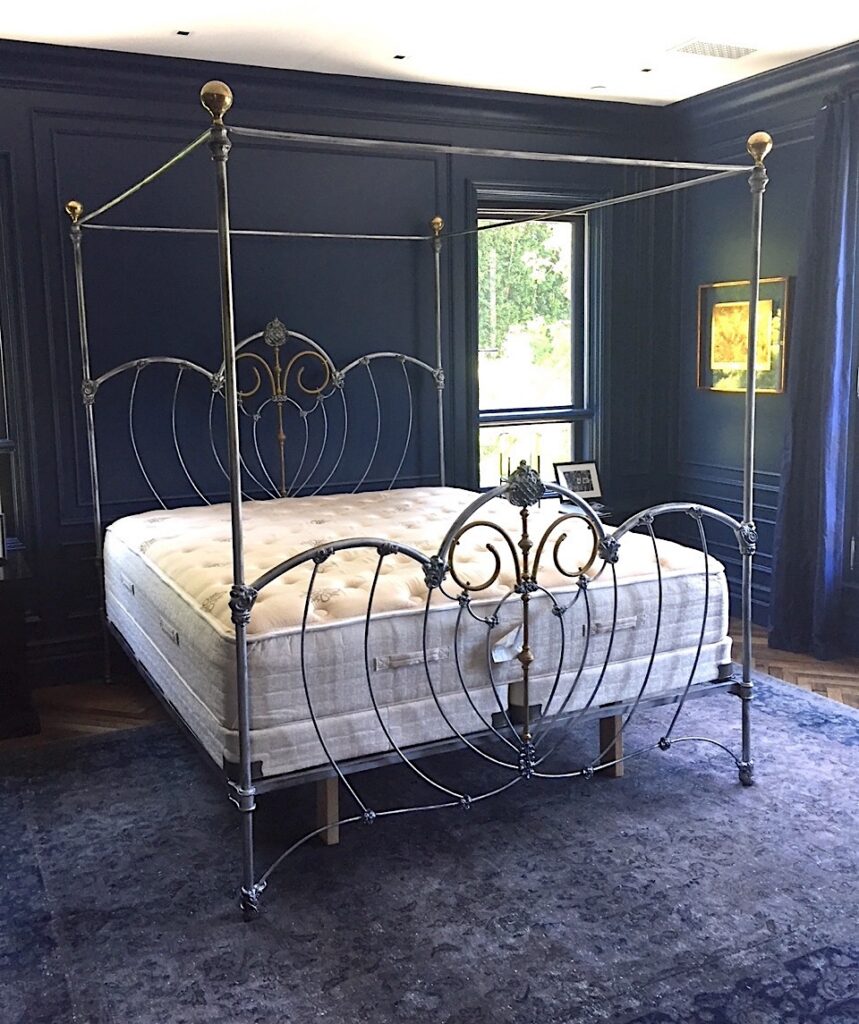
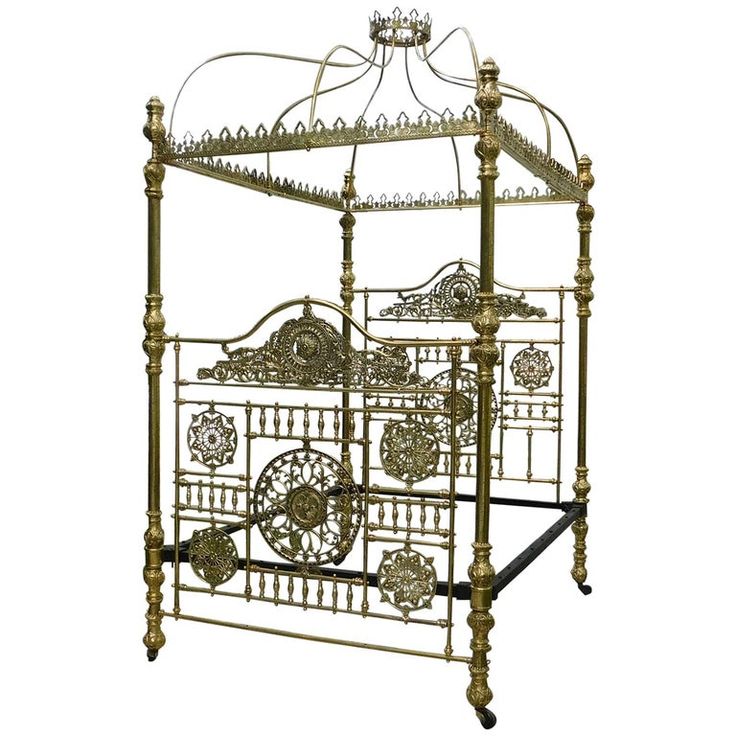
And why did the American four-poster iron bed become the closest thing we had to one?
There is something curious about antique iron beds that has always fascinated me.
Travel through the history of European furniture and you will find beautiful canopy beds almost everywhere. Go back far enough and the reasons are obvious. Canopy beds weren’t originally created simply because someone thought they looked romantic.
They were practical.
They helped keep warmth around the sleeper in cold rooms. They offered privacy when families, servants and sometimes entire households slept in the same room. And in much earlier times, when ceilings could be anything from rough timber to thatch, a covering over the bed could provide at least some protection from whatever might fall from above.
But then you cross the Atlantic and something changes.
America certainly had high-post and canopy-style beds. In fact, museum collections prove that American examples existed as far back as the 1700s. One American bedstead dating from approximately 1760–1800 even had fabric-covered cornices with curtains that could be lowered at night specifically for warmth and privacy.
So the question isn’t really, “Why didn’t Americans make canopy beds?”
The more interesting question is:
Why didn’t the canopy bed become nearly as important to American bedroom furniture as it had been in Europe?
And that may have a great deal to do with the difference between the world America inherited and the world it was becoming.
The Canopy Bed Had a Job to Do
In medieval and early European homes, a bed could be expected to do considerably more than simply provide a place to sleep.
In a large household, privacy was a luxury.
People often lived and slept in close quarters, and the bedroom as we think of it today—an entirely private room belonging to one individual or couple—was hardly universal.
A bed surrounded by heavy curtains created a small private world inside a larger shared room.
And then there was warmth.
European houses could be cold, particularly at night. Heavy curtains around a bed helped create a smaller pocket of warmth around the person sleeping beneath them.
In earlier buildings, there were other practical considerations as well. A bed covering could provide some protection from dust, insects and the occasional unpleasant surprise from above.
The canopy therefore had a purpose.
It wasn’t simply decoration.
Over time, however, houses improved. Bedrooms became more private. Heating improved. Building construction improved. And the practical reasons for surrounding a bed with heavy fabric gradually diminished.
What remained was the beauty.
And that is when the canopy bed began its transformation from necessity to luxury.
But America Had High-Post Beds
 Here’s where the story gets especially interesting.
It would be wrong to suggest that Americans simply ignored the European tradition.
They didn’t.
Colonial Williamsburg has American high-post beds dating from the 1700s, including examples with four tall posts designed to support a wooden upper frame or “tester.” It also has an American field bed dating from approximately 1780–1820 with an actual canopy frame.
And the Metropolitan Museum of Art has several American bedsteads from the 18th and early 19th centuries showing that elaborate, tall beds were certainly part of American furniture culture.
So America knew the canopy bed.
America simply didn’t seem to develop the same enduring obsession with it.
Why?
Perhaps America Didn’t Need One Quite as Much
This is where I think geography and architecture may tell us part of the story.
America was a young country.
Throughout much of the 18th and 19th centuries, it was growing, expanding and building. American homes were developing their own architectural character rather than simply reproducing the enormous medieval rooms, manor houses and castles of Europe.
And American life was changing rapidly.
The European canopy bed had evolved over centuries in an environment where the practical reasons for it were very real. By the time America was developing its own furniture traditions, many of those original requirements were already becoming less important.
Privacy was increasingly provided by the room itself.
Warmth was increasingly provided by the house itself.
And protection from the ceiling was increasingly provided by better construction.
There was less reason to build a miniature room around the bed.
That doesn’t mean Americans didn’t appreciate elaborate furniture. Quite the opposite.
The 19th century would become one of the great eras of American furniture ornamentation.
But American taste was developing in its own direction.
Then Came the Iron Bed
 And this is where the story becomes particularly relevant to anyone who loves antique iron beds.
By the middle and latter part of the 1800s, iron was becoming an increasingly important material for American bed manufacturing.
Industrialization changed everything.
Iron could be produced in quantities that earlier generations couldn’t have imagined. It could be formed, cast and decorated. And unlike massive wooden furniture, an iron bed could be visually elaborate without necessarily looking heavy.
The American bedroom was changing.
And instead of recreating the old European canopy bed in iron, American manufacturers seem to have found another solution:
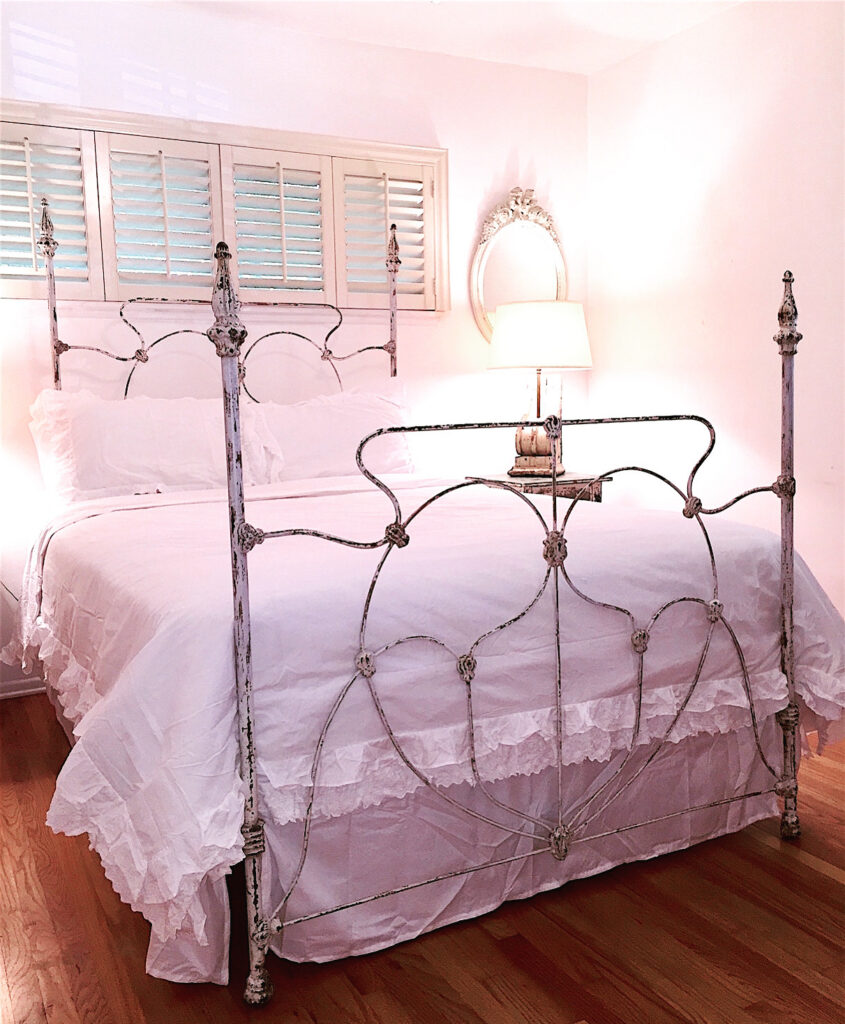
Keep the four posts. Lose the canopy.
And the Four Poster iron bed was born as an especially interesting American expression of that idea.
The tall posts provided the vertical drama of a canopy bed without requiring the fabric framework across the top.
The result was cleaner.
More open.
And, perhaps most importantly, more suited to the way American bedrooms were evolving.
The American Four Poster: A Canopy Without the Canopy
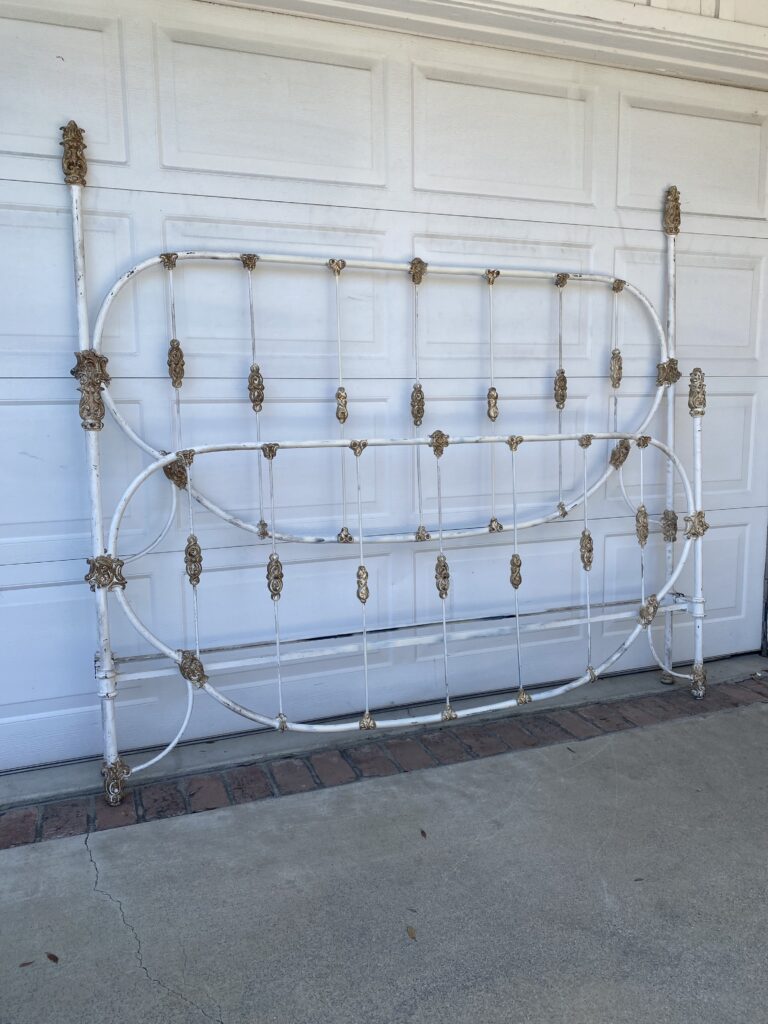 This may be the most fascinating part of the story.
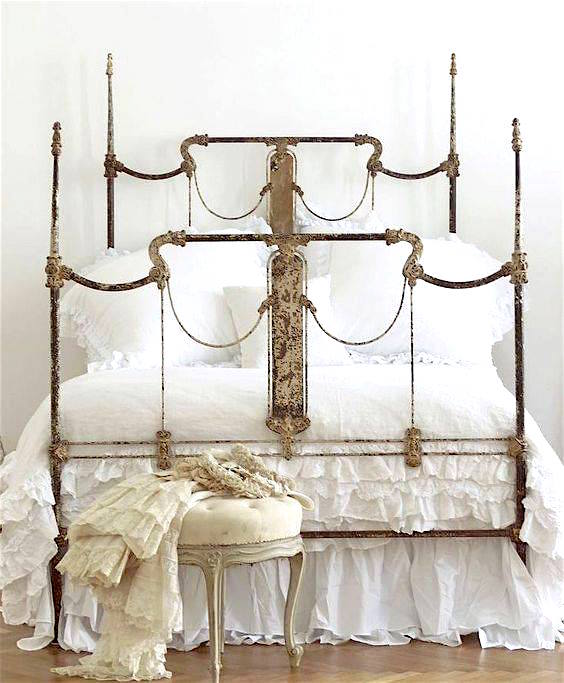
Look at a beautiful 19th-century American four-poster iron bed and you can almost see the ghost of the European canopy bed still hiding inside it.
There are four tall posts.
There is height.
There is symmetry.
There is an architectural quality that makes the bed command attention in a room.
But there is no roof.
No heavy curtains.
No enclosed sleeping chamber.
The bed has retained the visual language of the canopy while discarding much of its original practical baggage.
And that may be why the four-poster style worked so well in America.
It provided the grandeur without the enclosure.
It provided the height without the heaviness.
It gave the bedroom a dramatic focal point without turning the bed into a room within the room.
In other words, America may not have rejected the European canopy bed so much as Americanized it.
And There Was Another American Advantage: Light
There is another possibility worth considering.
American homes were increasingly embracing larger windows and brighter interiors.
A traditional European canopy bed—with substantial fabric overhead and curtains surrounding the sleeper—could visually close off a room.
An open iron four-poster did exactly the opposite.
The delicate lines of an antique iron bed allowed light to pass through the headboard and footboard.
That made it especially attractive in bedrooms where the bed itself needed to make a statement without becoming visually overwhelming.
And unlike a heavily upholstered canopy, an iron bed could remain remarkably airy.
That is one reason antique iron beds can still work so beautifully in today’s bedrooms.
They have presence without necessarily having visual weight.
The Canopy Didn’t Completely Disappear
Of course, we shouldn’t take this too far.
Canopy and high-post beds certainly continued to exist in America.
The Metropolitan Museum’s collection includes an elaborate American bedstead made around 1880, and other American examples demonstrate that wealthy households could still commission highly decorative bedroom furniture.
And American furniture makers were perfectly capable of producing sophisticated beds influenced by European design.
The point is not that Americans couldn’t make canopy beds.
They could.
The point is that the canopy bed never became the overwhelmingly dominant form of American iron bed that it had been in portions of Europe.
That’s a very different—and much more interesting—story.
Why This Matters When Looking at Antique Iron Beds Today
When you come across an authentic 19th-century antique iron bed with four tall posts, it is tempting to think of it simply as a four-poster bed.
But perhaps there is a little more history hiding in those four posts.
They are part of a much older story.
A story that begins with European beds designed for warmth, privacy and protection, moves through centuries of changing architecture and living conditions, and eventually arrives at an American interpretation where much of the practicality has disappeared and design takes center stage.
By the Victorian era, a bed didn’t necessarily need to protect its occupant from the cold or provide privacy from a room full of sleeping servants.
It could simply be beautiful.
And perhaps that is precisely what happened to the American four-poster iron bed.
It retained the romance of the canopy bed while becoming something distinctly American.
So… Why Didn’t America Make Canopy Beds?
Maybe the answer is not that America didn’t want canopy beds.
Maybe America simply didn’t need them in quite the same way.
Europe had centuries of history behind its canopy bed. It had cold stone rooms, shared sleeping quarters, enormous households, primitive heating and, in earlier centuries, roofs that could make a bed covering surprisingly practical.
America was developing under different circumstances.
As American homes became more private, better heated, better constructed and increasingly influenced by industrial manufacturing, many of the original reasons for the canopy disappeared.
What remained was the desire for something beautiful.
And the American answer may have been the Four Poster.
Four tall posts.
No canopy.
No curtains.
Just the elegant suggestion of what had come before.
And perhaps that is why I find the old American four-poster iron bed so interesting.
It isn’t merely a bed.
It may be one of the clearest examples of how American furniture took an idea that had been centuries old in Europe—and quietly made it its own.
**The Europeans kept the canopy.
America kept the four posts.**