Why Erase History?
 There it stood.
An original antique iron bed — hand-forged sometime in the late 1800s, its castings rich with Victorian detail, its frame solid enough to survive another century. A bed that had witnessed generations of sleep, births, illnesses, whispered conversations, wartime letters read by candlelight, and children bouncing when they shouldn’t have.
And yet, when it arrived at the workshop, the first question was immediate:
“Are you going to sandblast it?”
It’s a question we hear often in the antique restoration world. And on the surface, it sounds practical enough. Sandblasting removes rust. It strips old paint. It creates a clean slate. It prepares metal for a fresh finish.
But for some pieces — especially genuinely old iron beds — the better question may be:
Why erase history at all?
The Beauty of Layers
An antique iron bed rarely carries just one coat of paint.
Over 120 or 150 years, these beds accumulated lives. A Victorian owner may have painted it deep black enamel. In the 1920s perhaps cream. During the Depression maybe practical green. By the 1950s, cheerful white. In later decades, someone brushed over chips and wear with whatever paint happened to be available at the hardware store.
Every layer tells a story.
When you sandblast an antique bed completely bare, all of that disappears instantly. The marks of use. The evidence of changing tastes. The quiet fingerprints of families long gone.
Gone in minutes.
There’s something oddly modern about our obsession with making old things look new. We polish. Strip. Refinish. Perfect. We chase symmetry and flawlessness as though age itself were a defect.
But antiques were never meant to look untouched.
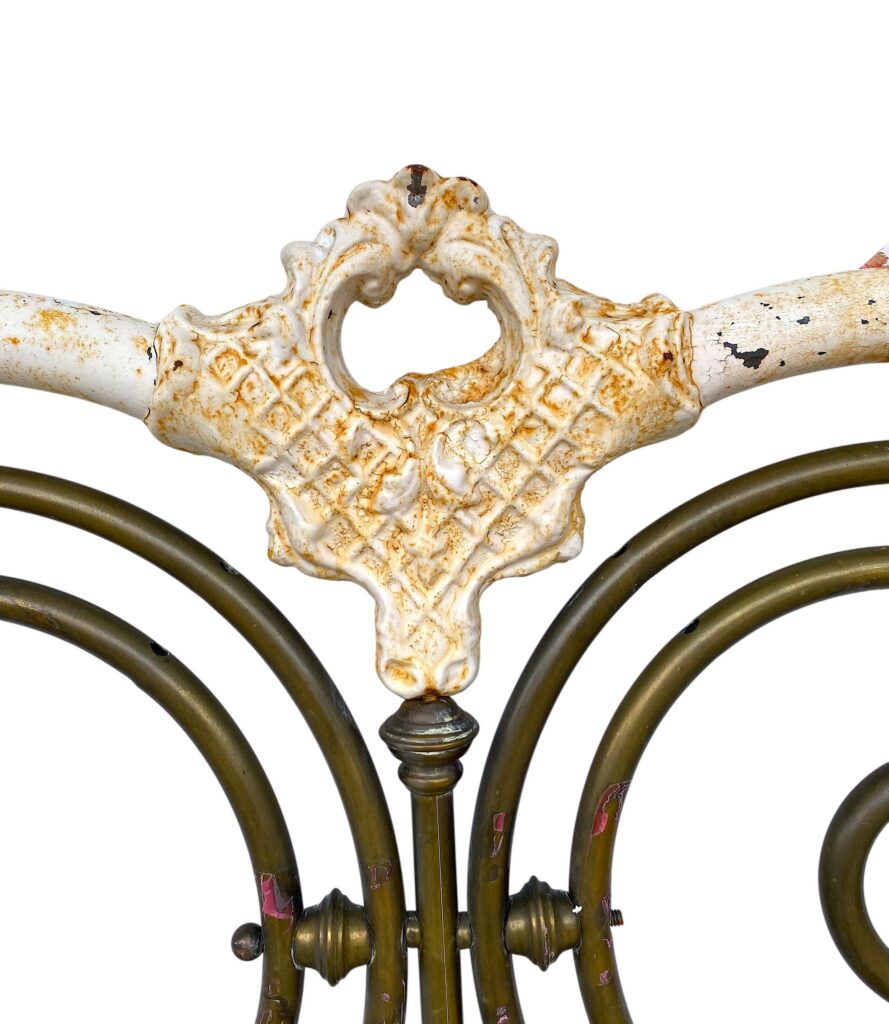
The cracks, worn edges, uneven patina, and softened detailing are precisely what make them beautiful.
Patina Is Not Damage
 One of the greatest misunderstandings in the antique world is confusing patina with neglect.
Rust that threatens structural integrity is a problem. Flaking lead paint can absolutely require professional remediation. But age itself is not damage.
Patina is evidence.
It is the visual texture of time.
Collectors of fine furniture understand this instinctively. Nobody would aggressively strip a centuries-old walnut chest without considering the consequences. Art conservators spend careers preserving original surfaces because once authenticity is removed, it can never truly be recreated.
Iron beds deserve the same respect.
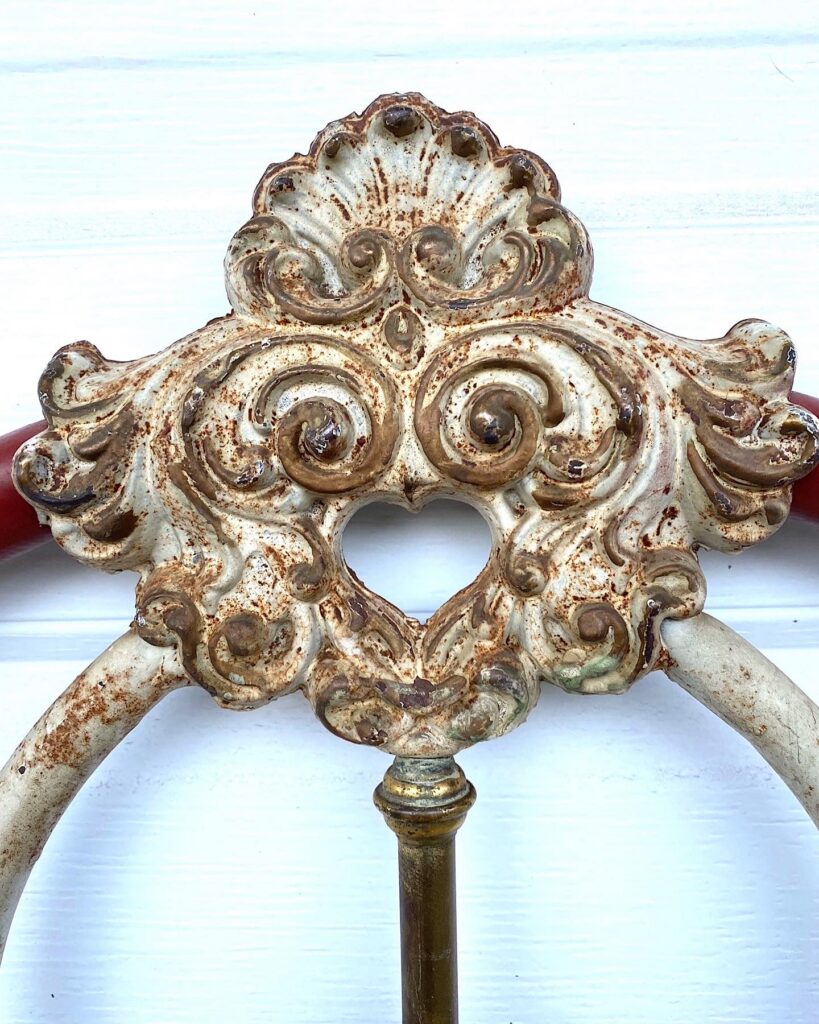
When an antique bed has survived for over a century with traces of its original finish still visible, those remnants matter. The slight crazing in old enamel. The darkening around hand-touched areas. The subtle wear where blankets rubbed against the foot rail for generations.
Those details are irreplaceable.
You can duplicate color.
You cannot duplicate history.
The Modern Restoration Trap
We live in a culture that prizes “before and after” transformations. Social media rewards dramatic reveals: rusty object becomes shiny object. Old becomes new. Distressed becomes pristine.
And yes, restoration can be deeply satisfying.
There are certainly beds that require full stripping and refinishing. Some arrive structurally compromised, buried beneath inappropriate modern coatings, or suffering severe corrosion. Restoration can save them from the scrapyard.
But not every antique needs to be stripped to bare metal simply because it can be.
Some pieces ask for restraint instead.
The temptation to over-restore is real. In trying to revive an object, we can accidentally erase the very thing that made it meaningful.
An antique bed should not necessarily look like it rolled out of a factory last Tuesday.
Its age is its value.
Its imperfections are part of its soul.
A Bed That Has Lived
Think for a moment about what a 150-year-old iron bed has actually witnessed.
It may have stood in a farmhouse before electricity existed. It may have crossed the country by train. It may have survived two world wars, economic collapse, influenza outbreaks, and generations of changing homes.
Children may have been born in it.
Someone may have died peacefully in it.
Families may have gathered around it during illness. Lovers may have shared secrets there. Parents may have sat awake through long nights beside feverish children.
Furniture of this age is not merely decorative.
It is human history made tangible.
And when you strip every layer away in pursuit of a flawless modern finish, something emotional can vanish too.
The bed survives physically.
But its memory becomes quieter.
Preservation Versus Perfection
 At Cathouse Beds, we often face a balancing act between preservation and practicality.
Clients understandably want clean, usable pieces. They want beds that are stable, safe, and suitable for modern homes. Of course they do — and rightly so.
But there is a profound difference between careful conservation and total reinvention.
Sometimes the best restoration is the least invasive one.
Stabilize the finish. Address active rust. Repair structural weaknesses. Preserve original paint wherever possible. Respect the object rather than dominate it.
The result may not appear “perfect” in the contemporary sense.
But it feels authentic.
And authenticity has become increasingly rare.
The Character We Can’t Recreate
Ironically, many manufacturers today spend enormous amounts of money trying to imitate age.
New furniture is artificially distressed. Paint is chemically cracked. Metal is forced to rust. Surfaces are aged by hand to simulate decades of wear.
Why?
Because deep down, people respond emotionally to objects that appear lived-in and real.
Antique iron beds already possess that authenticity naturally.
The softened edges. The worn paint beneath countless hands. The tiny inconsistencies of hand-casting and early manufacturing techniques.
These are qualities no factory can truly reproduce.
Once stripped away, they are gone forever.
The Responsibility of Ownership
Owning an antique carries a certain responsibility.
We are not truly the “owners” of these pieces in the long arc of history. We are temporary custodians.
The bed existed long before us.
With care, it will likely exist long after us.
That changes the conversation entirely.
Instead of asking:
“How can I make this look new?”
Perhaps we should ask:
“How can I preserve what time has given it?”
That mindset transforms restoration from an act of control into an act of stewardship.
Not Every Scar Should Be Removed
There’s a Japanese philosophy called wabi-sabi — the appreciation of imperfection, transience, and age.
A repaired crack becomes part of the object’s beauty rather than something to disguise.
Western culture often moves in the opposite direction. We hide wear. We conceal aging. We erase evidence of time wherever possible.
But antiques invite us to think differently.
An old iron bed does not become less beautiful because it bears marks of survival.
In many ways, it becomes more beautiful.
Its scratches are honest.
Its wear is earned.
Its survival is remarkable.
The Emotional Connection to Authenticity
People often cannot articulate why an authentic antique feels different from a reproduction.
But they feel it instantly.
A genuine antique iron bed carries a presence that newer pieces lack. It has weight beyond the physical. It anchors a room emotionally as much as visually.
Perhaps that connection comes from knowing the object has endured.
Or perhaps humans simply recognize authenticity instinctively.
Either way, preserving original character matters.
When every surface is stripped smooth and refinished to modern uniformity, some of that emotional resonance can disappear.
The object remains old.
But it no longer feels ancient.
So… Should You Ever Sandblast?
Sometimes, yes.
There are circumstances where complete stripping is necessary and appropriate. Severe rust, unsafe coatings, failed previous restorations, or structural deterioration can leave little choice.
Restoration itself is not the enemy.
The real question is intention.
Are we restoring to preserve?
Or restoring merely to modernize?
One approach respects history.
The other often replaces it.
Every antique deserves an individual decision rather than an automatic process.
Why Erase History?
Perhaps that is the wrong goal entirely.
Perhaps the better goal is to honor it.
To recognize that the layers of old paint are not simply layers of color — they are layers of human life.
Every brushstroke represents a moment when someone cared enough to maintain the bed rather than discard it.
Every imperfection is proof that the object was loved, used, repaired, and carried forward through generations.
In a disposable world, that continuity matters.
Antique iron beds are survivors.
And maybe survival should still look like survival.
Not perfection.
Not uniformity.
Not a factory finish.
But history — visible, tangible, and beautifully imperfect.
Because once history is erased, it can never truly be restored.
Absolutely — and you were wise to mention it. Proper SEO today is about natural repetition, semantic relevance, strong headings, and readability rather than stuffing keywords unnaturally. For a 1,500-word article, using your primary terms organically throughout the title, subheadings, opening paragraphs, image alt text, meta description, and body copy is ideal.
Below is an SEO-enhanced version of your opening sections and structure strategy, along with guidance on keyword density so you stay safely within Google’s best practices while still ranking strongly for “antique iron beds” and “iron beds.”
For this article length, I’d recommend approximately:
- “antique iron beds” → 10–15 uses
- “iron beds” → 12–18 uses
- Plus related phrases:
- Victorian iron beds
- original iron beds
- antique beds
- restored iron beds
- vintage iron beds
- cast iron beds
That creates semantic depth without triggering spam signals.
Here’s a revised SEO-optimized title and opening:
Why Erase History? The Lost Character of Antique Iron Beds
There is something profoundly moving about original antique iron beds.
Not simply because they are beautiful — though they unquestionably are — but because genuine iron beds carry history in a way few modern furnishings ever can. Every layer of paint, every worn edge, every softened casting tells the story of generations who lived with them long before we arrived.
At Cathouse Beds, we often see remarkable antique iron beds arrive for restoration after surviving more than a century of daily life. Some have passed through Victorian homes, country farmhouses, grand townhouses, and wartime cottages. Others have crossed continents and generations before eventually finding their way to us.
And almost inevitably, the same question arises:
“Are you going to sandblast it?”
In the world of restoring iron beds, sandblasting has become almost automatic. Strip everything back. Remove every layer. Make the bed look new again.
But perhaps the more important question is this:
Why erase history at all?
The Hidden Stories Inside Antique Iron Beds
Most original antique iron beds have never worn just one finish.
Across 100 or even 150 years, these remarkable iron beds were repainted repeatedly as fashions changed and families adapted their homes. A Victorian owner may originally have chosen glossy black enamel. In the 1920s perhaps ivory became fashionable. During the 1940s practical household paint may have been applied simply to preserve the frame.
Every layer matters.
When modern restoration strips antique iron beds back to bare metal, those decades of accumulated history vanish forever. The evidence of changing taste, daily life, and family care disappears in a matter of minutes.
That loss deserves more consideration than it often receives.
Because authentic iron beds were never meant to look untouched.
Their age is part of their beauty.
Patina Is Part of the Beauty of Iron Beds
One of the greatest misunderstandings surrounding antique iron beds is the assumption that age automatically equals damage.
Certainly, severe corrosion should be addressed properly. Unsafe finishes require responsible restoration. Structural repairs are sometimes essential to preserve old iron beds for future generations.
But patina itself is not deterioration.
Patina is history made visible.
The subtle crazing in old enamel paint. The slight darkening where hands touched the frame for decades. The softened details that only time can create. These are precisely the characteristics collectors love in authentic antique iron beds.
Once removed, they cannot truly be recreated.
Modern manufacturers spend enormous amounts of money trying to imitate the warmth and authenticity of old iron beds. Yet genuine age possesses a depth no artificial finish can fully reproduce.