
Why One Pair of Rails Rarely Fits Another Antique Iron Bed
 Anyone who has spent time around antique iron beds has probably heard the same statement repeated countless times:
“Aren’t all the side rails the same?”
It’s one of the biggest misconceptions surrounding iron beds, and unfortunately, it’s also responsible for countless damaged bed frames over the last century.
The truth is that the side rails of antique iron beds are anything but universal.
In fact, they are arguably the Achilles heel of every authentic antique iron bed ever made.
Understanding why can save collectors, homeowners, restorers, and antique dealers from making an expensive—and sometimes irreversible—mistake.
The Lost World of Small American Foundries
 During the second half of the nineteenth century, America was experiencing tremendous industrial growth. While many people imagine only a handful of large manufacturers producing iron beds, the reality was far different.
There were literally thousands of independently owned foundries scattered across the United States. Most served only a relatively small geographic region surrounding their community.
A foundry in Pennsylvania might never compete with one in Missouri. A manufacturer in Ohio often sold only within neighboring states. Transportation was expensive, and most companies focused on local markets.
Each foundry proudly developed its own bed designs, decorative castings, and construction methods.
They also created something that today causes collectors endless headaches:
Their own unique side rail system.
Every Foundry Had Its Own Design
The side rails of antique iron beds were made from heavy angle iron, but the real engineering was found at each end of the rail.
Rather than simply drilling holes for bolts as modern beds do today, foundries cast a specially shaped connector onto the end of every side rail.
The headboard and footboard contained matching cast “hitches” or receptacles designed specifically for that connector.
Think of it as a lock and key.
Although two rails may appear nearly identical from several feet away, the actual tapered connector hidden inside the hitch often differs by only a few fractions of an inch.
Those tiny differences make all the difference.
 The Importance of the Taper
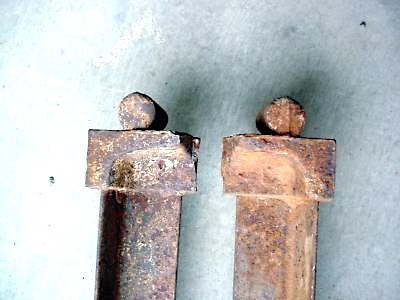
One of the most overlooked details is the taper of the cast connector.
Every foundry produced its own molds.
Some created a steeper taper.
Others used a shallower angle.
Some were slightly wider.
Others slightly narrower.
Even differences that seem almost invisible can prevent the connector from seating properly inside the hitch.
The result?
The rail may hook into the bed…
…but it never locks tightly into place.
Instead of becoming one solid frame, the entire bed develops movement.
That familiar wobble that many people assume is simply “because it’s old” is often caused by rails that were never intended for that particular bed.
Why Rails Became Separated
Over the past 125 to 150 years, many antique iron beds have lived several lives.
Families moved.
Homes were sold.
Furniture was stored in barns, basements, garages, and attics.
Estate sales separated pieces.
Moving companies misplaced hardware.
Sometimes homeowners simply discarded the rails because they didn’t understand their importance.
Eventually, a beautiful headboard and footboard might survive while the original rails disappeared forever.
Years later, someone finds another pair of antique rails at a flea market and assumes they will fit.
Unfortunately…
they usually don’t.
“Close Enough” Usually Isn’t
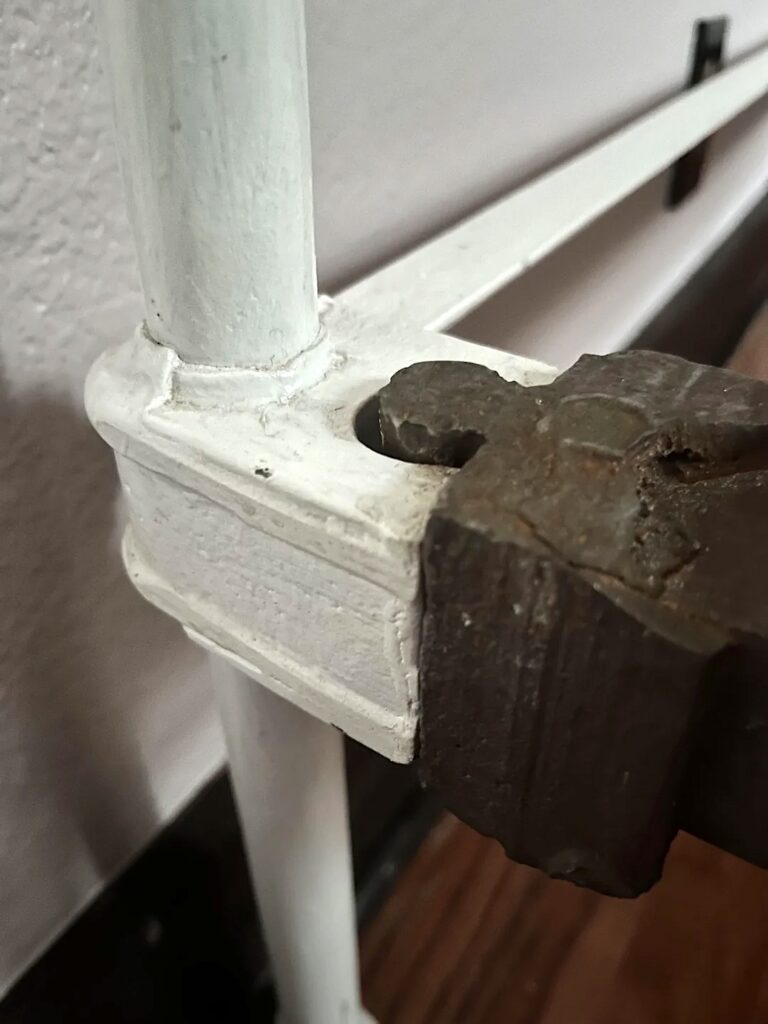 Many replacement rails will appear to fit at first glance.
The connector enters the hitch.
The bed stands upright.
Everything seems fine.
Until someone sits on the mattress.
Suddenly the frame shifts.
The headboard rocks.
The footboard moves.
The rails rattle.
That’s because the connector isn’t fully seated against the taper inside the hitch.
Even a tiny amount of movement becomes magnified once several hundred pounds of mattress and occupants are added.
A properly fitted antique iron bed should feel surprisingly solid.
If it doesn’t, there’s usually a reason.
The Biggest Mistake Owners Make
Here’s where many antique beds suffer permanent damage.
A frustrated owner notices the rails are loose.
Instead of recognizing the rails are incorrect, they assume they simply need to be driven in farther.
Out comes the hammer.
Sometimes even a sledgehammer.
Repeated blows force the tapered connector against cast iron that was never designed for that particular shape.
Something eventually gives.
Unfortunately, it usually isn’t the rail.
It’s the cast hitch attached to the headboard or footboard.
Or worse, the cast connector itself breaks away from the rail.
Why Broken Connectors Are Such Bad News
 Cast iron is incredibly strong under compression.
It is also surprisingly brittle when subjected to shock.
When a connector snaps off, many people ask whether it can simply be welded.
Technically, cast iron can sometimes be repaired by experienced specialists.
However, the repaired connector almost never regains its original strength.
The repeated stresses placed on the side rails every time someone climbs into bed eventually expose even the best repair.
The repair may hold for a while…
or it may fail at exactly the wrong moment.
For this reason, original undamaged side rail connectors are among the most valuable parts of an authentic antique iron bed.
Why Original Rails Matter
Collectors often focus on ornate castings, brass finials, and beautiful paint.
Yet experienced restorers know that the original side rails are every bit as important.
Original rails provide:
- The proper fit.
- Maximum structural stability.
- Correct alignment.
- Safe everyday use.
- Preservation of the bed’s originality.
Without properly matched rails, even the most beautiful antique iron bed can become frustrating to assemble and unpleasant to sleep on.
One Advantage Some Foundries Had
Not every situation was quite as complicated.
Many foundries produced multiple bed designs while continuing to use the same rail system throughout their product line.
That meant one set of rails could often interchange among beds produced by that specific manufacturer.
Unfortunately, those rails generally would not fit beds from neighboring foundries.
The interchangeability stopped at the factory gate.
This is one reason identifying the original manufacturer can sometimes be extremely valuable when searching for replacement rails.
The Evolution of Bed Construction
As manufacturing became more standardized during the early twentieth century, bed construction gradually changed.
Instead of relying entirely on tapered hook systems, manufacturers increasingly adopted bolts, screws, and other mechanical fasteners.
These systems were easier to manufacture.
They simplified assembly.
They allowed greater interchangeability.
Most importantly, they reduced the compatibility problems that had plagued earlier beds.
Modern bed frames owe much of their convenience to these standardized fastening methods.
But for collectors of genuine nineteenth-century antique iron beds, the earlier hook-and-hitch system remains one of the defining characteristics of authentic construction.
Buying an Antique Iron Bed? Ask About the Rails
If you’re shopping for antique iron beds today, always ask one important question:
“Are these the original side rails?”
Don’t assume.
Don’t guess.
Ask.
If the seller isn’t certain, examine how securely the rails fit the headboard and footboard.
A quality antique bed should assemble without excessive force.
The rails should seat fully into their hitches without hammering.
Once assembled, the bed should feel remarkably solid.
If it wobbles significantly before a mattress is even installed, investigate why.
A Small Detail That Makes All the Difference
It’s easy to admire the graceful curves, decorative castings, and timeless beauty of antique iron beds.
Few people ever notice the engineering hidden beneath the mattress.
Yet those humble side rails quietly perform the most important job of all.
They transform four separate pieces of iron into one rigid, stable structure capable of supporting generations of sleepers.
When the original rails remain with the bed, they become an invisible testament to the skill of nineteenth-century foundry craftsmen.
When they are lost, replaced, or damaged, the consequences can affect the bed forever.
That is why knowledgeable collectors, experienced restorers, and reputable dealers place such importance on preserving original side rails whenever possible.
They may not be the most glamorous part of an antique iron bed, but they are unquestionably one of its most essential components.
For anyone considering the purchase of antique iron beds, remember this simple rule:
Never judge a bed by its headboard alone.
The side rails may very well determine whether your beautiful antique becomes a sturdy heirloom that lasts another hundred years—or a frustrating restoration project searching for parts that were never meant to fit.
Sometimes the smallest pieces carry the greatest responsibility.
And in the world of antique iron beds, the side rails truly are the Achilles heel.