
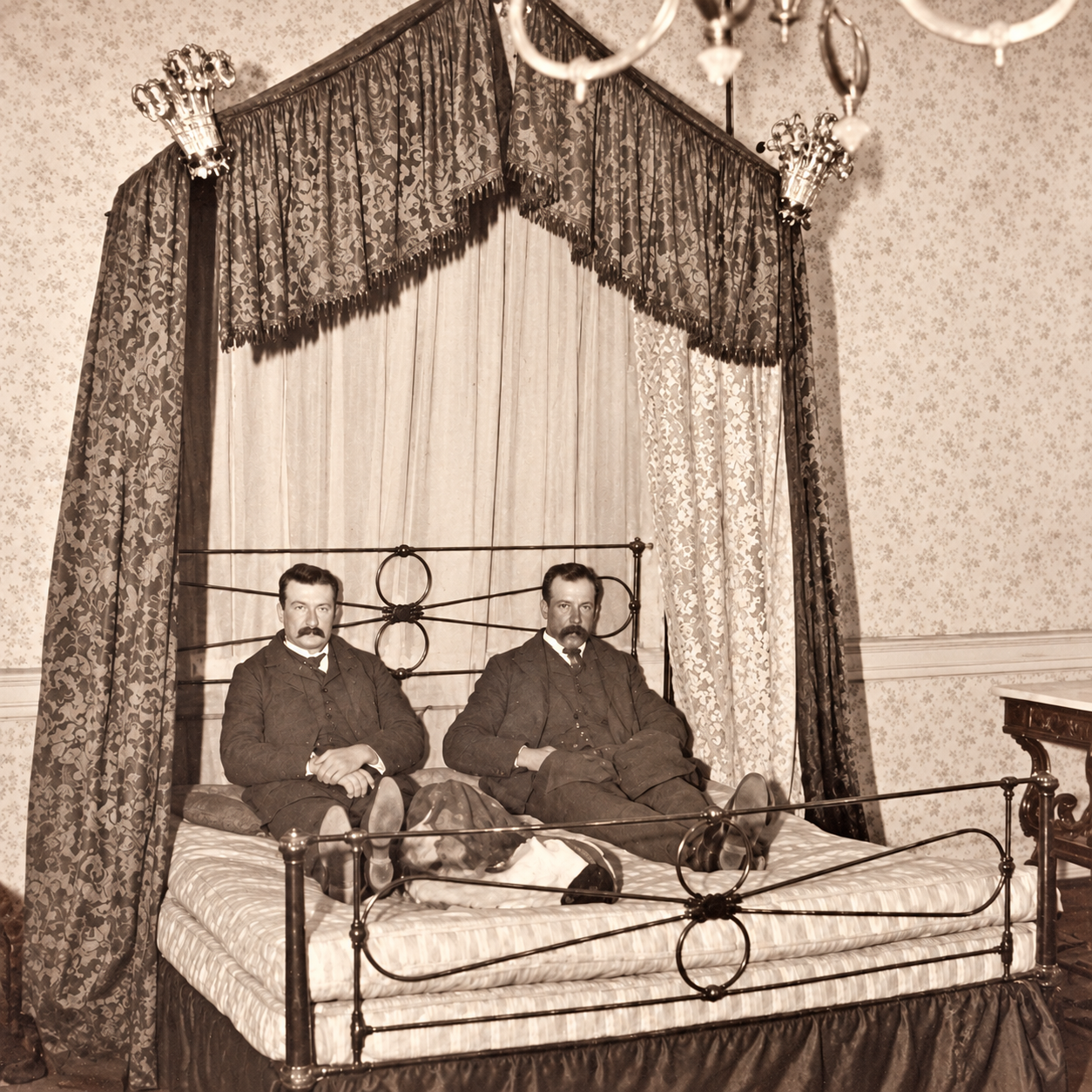
For those of us who work with antique iron beds, one of the most common questions we hear is surprisingly simple:
“Why are so many antique beds so small?”
The answer takes us back to the Victorian era, when the choices in bed sizes were considerably simpler than they are today.
There was no queen. There was no standard king. And certainly no California king.
For much of the period in which American antique iron beds were being manufactured, the familiar sizes were essentially the twin or single, the intermediate three-quarter size, and the double or full size.
A twin was approximately 39 inches wide by 75 inches long.
The less standardized three-quarter beds could measure roughly 43 to 48 inches wide, generally around 75 inches long.
And then there was the largest commonly produced size—the double or full, approximately 54 inches wide by 75 inches long. Historical bed dimensions were not always as standardized as modern mattress dimensions, so surviving antique frames can vary somewhat.
That was essentially the world of American bed sizes.
And for generations, people apparently made do with it.
Imagine Two Adults Sharing 54 Inches
This is where the story becomes interesting.
A modern twin mattress is about 38 or 39 inches wide. Put two adults into a 54-inch-wide Victorian double bed and each person effectively has only about 27 inches of sleeping width.
By comparison, two people sharing today’s 76-inch-wide standard king each have approximately 38 inches—roughly the width of an entire twin mattress.
Think about that for a moment.
For generations, married couples routinely shared a bed that gave each person considerably less sleeping space than we would consider normal today.
Yet during the Victorian era, a 54-inch double wasn’t regarded as particularly small. It was the large bed.
In my 50 years of buying and selling antique iron beds, the overwhelming majority of the larger original beds I’ve encountered have been doubles. Truly oversized examples from the period are so unusual that when one turns up, I immediately wonder whether it might have been specially commissioned.
So what happened?
Why did a country that had been content sleeping on doubles suddenly decide it needed queens and kings?
Yes, Americans Really Were Getting Bigger
Part of the answer is physical.
Americans were becoming taller.
By the middle of the twentieth century, the bedding industry was actively pointing this out. A historical account of the industry’s advertising efforts notes that Americans were growing taller compared with their counterparts at the beginning of the century.
A remarkable 1964 TIME article about America’s new enthusiasm for oversized beds put some numbers behind the change. It reported that the proportion of American men standing six feet or taller had risen substantially since 1900.
Suddenly that old 75-inch mattress didn’t seem quite so generous.
Today’s queen and standard king mattresses are generally 80 inches long, five inches longer than the traditional 75-inch twin and double.
But increased height alone doesn’t explain the revolution.
Something else had changed.
The American Bedroom Got Bigger Too
Following World War II, millions of Americans moved into newly constructed suburban houses.
Compared with many older urban homes, cottages and farmhouses, these houses could offer larger bedrooms and more room for furniture.
At the same time, postwar prosperity was changing American consumer expectations. Families were buying televisions, automobiles, refrigerators and countless other products promising greater comfort and convenience.
Why shouldn’t the bedroom improve as well?
The mattress industry recognized the opportunity.
Larger mattresses had begun appearing in the mid-1940s, but initially consumers weren’t exactly racing to buy them. The real push toward what the bedding industry called “supersizes” came during the 1950s.
This wasn’t simply consumers demanding larger beds.
Manufacturers actively taught Americans to want them.
The Mattress Industry Asked a Brilliant Question
Instead of asking:
“Is your old double bed worn out?”
the industry effectively began asking:
“Why are the two of you trying to sleep in something so small?”
That was a much more powerful sales proposition.
A new mattress wasn’t merely a replacement anymore. A larger mattress could be sold as an improvement in the quality of your sleep and your life.
Manufacturers emphasized that couples needed more room to move comfortably during the night. Advertising promoted larger beds as modern, luxurious and conducive to better sleep.
There was also an attractive economic reason for manufacturers to promote them.
A larger mattress required additional material, but it could command a significantly higher selling price. One industry history notes that larger sizes added relatively little to manufacturing costs while creating an opportunity for greater profit.
In other words, Americans may have needed more room—but the bedding industry was certainly happy to remind them of it.
1958: Queen and King Go Mainstream
This is where I would place the major turning point.
According to Serta Simmons Bedding’s corporate history, Beautyrest introduced queen- and king-size mattresses in 1958.
The modern queen eventually settled at approximately 60 inches wide by 80 inches long, while the standard or Eastern king became approximately 76 inches wide by 80 inches long.
Consumers didn’t switch overnight.
Changing a mattress size meant changing the bed, sheets and other bedding as well. People had been sleeping on twins and doubles for generations.
But once the idea took hold, it moved quickly.
By 1964, TIME reported that about 10% of mattresses sold the previous year were oversized, roughly double the proportion only three years earlier.
The American bedroom had changed permanently.
And That Created a Problem for Antique Iron Beds
Fast-forward another half century and we arrive at a problem I’ve spent a good portion of my career solving.
The Victorian craftsmen who made our antique iron beds couldn’t possibly have anticipated that future generations would expect 60-, 76- or even 72-by-84-inch mattresses.
They built beds for the mattresses and sleeping habits of their own time.
Unfortunately, many spectacular antique iron beds were consequently passed over by modern buyers simply because they were doubles.
That has always seemed a shame to me.
A magnificent 130-year-old iron bed shouldn’t become obsolete simply because Americans decided they wanted another six, twenty or thirty inches of sleeping room.
And that’s precisely why queen and king conversions have become such an important part of what we do at Cathouse Antique Iron Beds.
Enlarging the Bed Without Redesigning It
Converting an antique iron bed is not—or at least shouldn’t be—a matter of simply welding some additional tubing onto it.
Our objective has always been different.
Respect the original design.
When enlarging an antique double into a queen or king, the challenge is to imagine what the original foundry might have produced had a customer walked through its doors in 1890 and requested a 76-inch-wide bed.
Curves need to continue naturally. Scrolls must remain properly proportioned. Additional castings sometimes have to be reproduced. Welds need to disappear into the construction rather than announce themselves.
The finished conversion shouldn’t look like an old double bed that somebody stretched.
It should look as though it was always that size.
That requires welders, metal craftsmen, finishers and, in certain conversions, foundry work to reproduce castings needed to maintain the integrity of the original pattern.
We aren’t trying to redesign history.
We’re trying to make history usable.
From 27 Inches to 38 Inches Per Person
Perhaps nothing illustrates the change in American sleeping habits better than those two numbers.
A couple sharing a Victorian 54-inch double had approximately:
27 inches per person.
A couple sharing today’s 76-inch standard king has approximately:
38 inches per person.
That’s an additional 11 inches of personal sleeping width for each person.
And the mattress grew five inches longer as well.
So were our Victorian ancestors simply tougher sleepers?
Perhaps.
But their expectations were different. Their houses were different. Their bedrooms were different. Their bodies were somewhat different, and the consumer culture surrounding sleep was enormously different.
What seems cramped to us today was perfectly ordinary to them.
The Bed Changed Because America Changed
And I think that’s the most interesting part of the story.
The arrival of queen- and king-size beds wasn’t caused by one single development.
Americans became taller. Homes became larger. Postwar prosperity increased. Expectations of personal comfort changed. Couples wanted more individual sleeping space. Mattress technology and mass production improved. And manufacturers discovered that bigger beds were both marketable and profitable.
Together, those changes finally ended the centuries-long dominance of the double bed.
Today, the irony is that we’re taking some of those magnificent Victorian doubles—the very beds rendered impractical by the invention of the queen and king—and giving them another century of useful life.
The mattress may have changed.
The way we sleep may have changed.
But fortunately, the craftsmanship of a great antique iron bed never went out of style.
Cathouse Antique Iron Beds
Original Antique Iron Beds • Restoration • Queen & King Conversions
Cathousebeds.com