
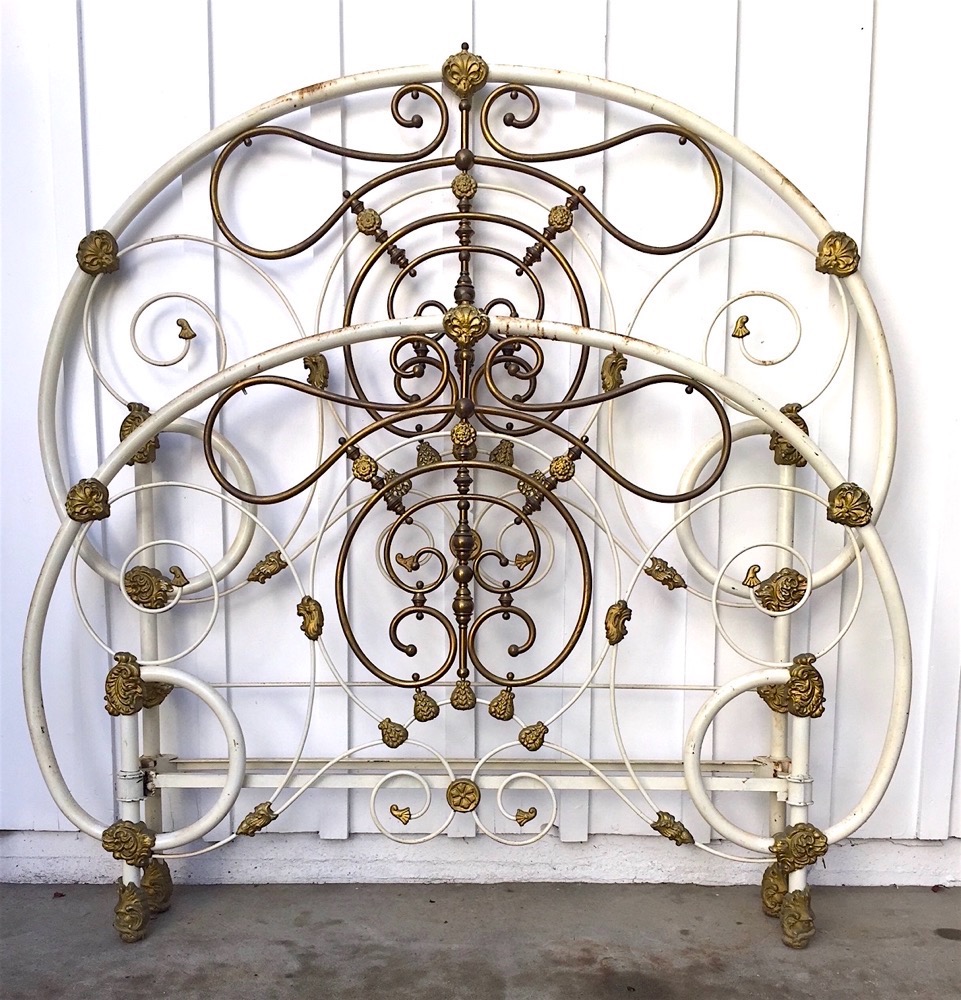
Look closely at almost any highly decorative antique iron bed from the 1800s and there is a good chance you’ll find some form of scrolling.
Sometimes it is obvious: a large sweeping S-shaped piece of iron filling the center of a headboard.
Sometimes it is more subtle: two opposing curves surrounding a floral casting, a curled piece of iron terminating in a leaf, or a series of smaller C-shaped curves creating an elaborate repeating pattern.
After more than 50 years of working with antique iron beds, I’ve handled thousands of examples incorporating these designs.
But here’s the interesting part:
The iron-bed manufacturers didn’t invent the scroll.
Not even close.
By the time Victorian foundries began incorporating scrolling into iron bedsteads during the 1800s, artists, architects, stone carvers, woodworkers, blacksmiths and metalworkers had already been using variations of the scroll for thousands of years.
So where did scrolling actually come from?
And how did a decorative idea with roots in the ancient world eventually wind up in the headboard of an American antique iron bed?
First—What Exactly Is a Scroll?
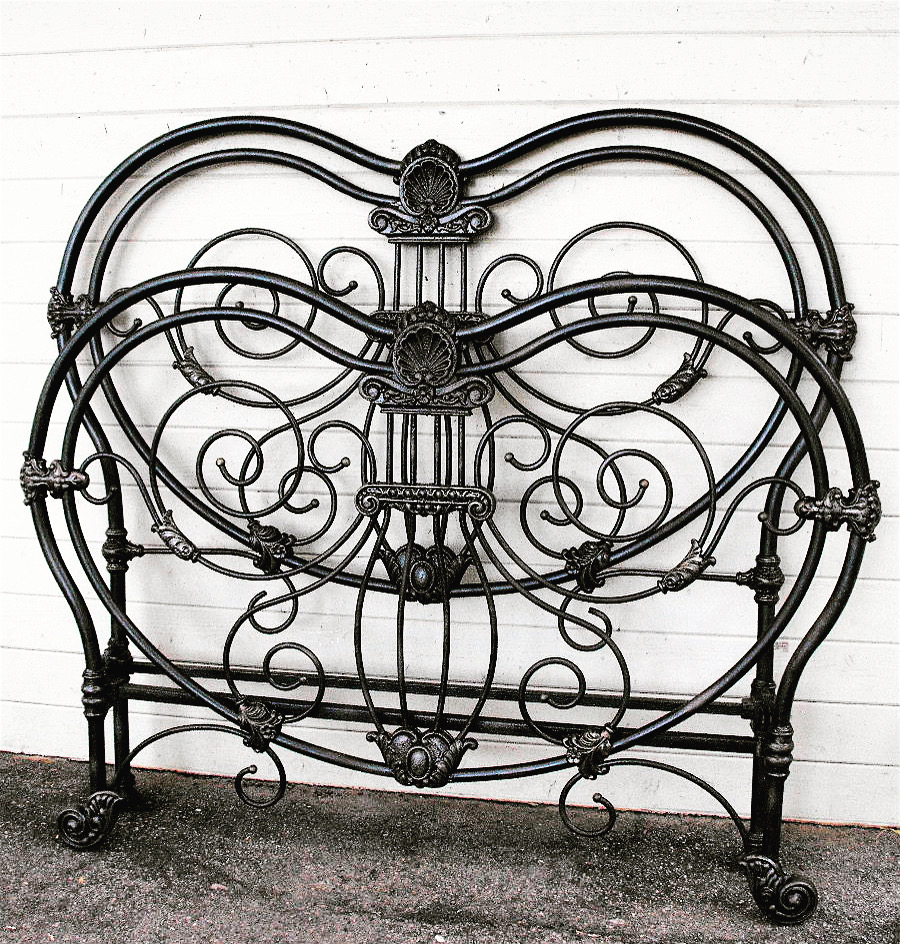 In decorative design, a scroll is essentially a line or form that curls, coils or rolls back upon itself.
Think of a vine growing around something.
Think of the spiral of a shell.
Think of the unfurling end of a fern.
Or simply draw the letter S.
You’ve just created one of the fundamental shapes behind centuries of decorative scrollwork.
That simplicity may help explain why scrolling appears in so many different cultures and periods. The basic spiral and curling line are forms found everywhere in nature.
For that reason, there probably wasn’t a single person who sat down one afternoon and “invented” scrolling.
It evolved.
Human beings have been using spirals, curling lines and repeating curved patterns since antiquity. What changed over the centuries was the sophistication of the design and the materials craftsmen learned to manipulate.
The Ancient Origins
Some of the most important ancestors of the scroll can be found in the decorative arts of ancient Greece.
Greek craftsmen used spirals, palmettes, vines and stylized foliage extensively in architecture, pottery, bronze work and other decorative objects.
One of the most famous examples is the volute—the spiral-shaped ornament associated particularly with the Ionic architectural order.
Then there was the acanthus.
The acanthus plant became one of the great decorative motifs of classical architecture. Its leaves were stylized and incorporated into architectural ornament, particularly the elaborate Corinthian capital.
Over time, leaves, stems and vines began flowing outward into curling, repeating forms.
The Romans took this decorative vocabulary and ran with it.
Roman architecture contains magnificent examples of scrolling vegetation—acanthus leaves, vines, flowers and stems curling across stone surfaces. Surviving Roman marble decoration from the first century shows remarkably sophisticated acanthus scrolls.
So when we look at a Victorian antique iron bed containing an S-scroll ending in a leaf, we’re looking at the distant descendant of a decorative idea that was already well established roughly two thousand years earlier.
Nature Was Probably the Greatest Designer of All
One reason scrolling has survived for so long may be remarkably simple.
Nature doesn’t contain very many perfectly straight lines.
Vines twist.
Branches curve.
Flowers open.
Leaves curl.
Waves roll.
Shells spiral.
And those natural forms have continually supplied designers with inspiration.
This is especially important when looking at antique iron beds because so many of their decorative castings combine scrolling with flowers and leaves.
That wasn’t accidental.
The curve and the botanical ornament belonged together long before anyone manufactured an iron bed.
Rome Falls—but the Scroll Doesn’t Disappear
Classical ornament never completely vanished.
Forms based upon vines, foliage and spirals continued through medieval European art and architecture, appearing in manuscripts, stone carving, church decoration, metalwork and furniture.
Then came the Renaissance.
Beginning in Italy and spreading throughout Europe, Renaissance artists and architects deliberately rediscovered the art and architecture of ancient Greece and Rome.
Suddenly classical ornament was fashionable again.
Acanthus leaves returned.
Volutes returned.
Vines returned.
And scrolling became an increasingly important part of the European decorative vocabulary.
The development of printing also helped spread ornamental designs. Craftsmen no longer necessarily had to travel hundreds of miles to see a particular architectural detail. Engraved ornament books and pattern sheets could circulate designs from one workshop to another.
A scroll created by an architect or designer could therefore influence a woodcarver, silversmith, furniture maker—or metalworker.
Design was becoming portable.
Then the Baroque Really Let the Scroll Loose
 During the 1600s and early 1700s, the Baroque period embraced movement and dramatic ornament.
Scrolling foliage became particularly important.
The Victoria and Albert Museum describes the running scroll—often combined with stylized acanthus—as one of the most widespread forms of Baroque floral decoration.
This is an important step in our story.
The scroll was no longer merely a small architectural detail.
It could become the design.
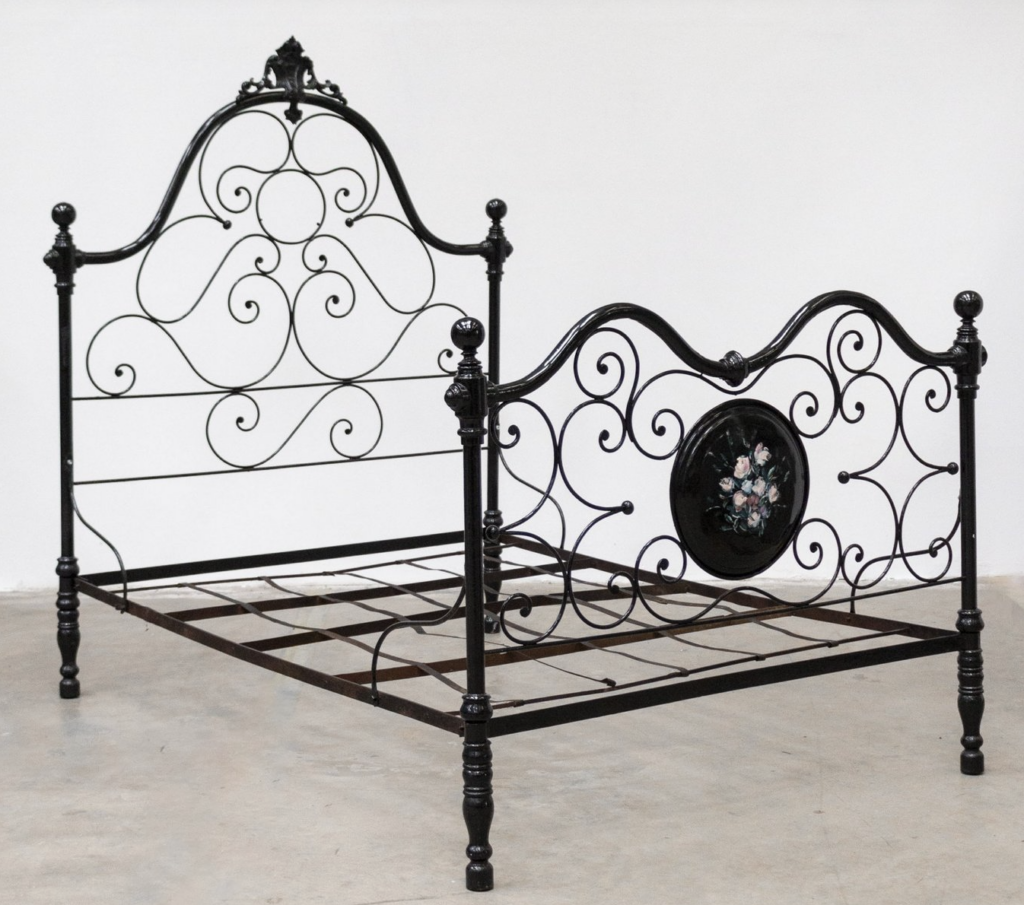
Large C-scrolls and S-scrolls could frame mirrors, furniture, architectural panels, gates and decorative metalwork.
Woodworkers carved them.
Silversmiths engraved them.
Stone carvers sculpted them.
And blacksmiths forged them.
By the late 1600s, printed designs were circulating specifically for craftsmen showing elaborate scrolling acanthus ornament.
The vocabulary that would eventually appear on Victorian iron beds was already firmly established.
Iron Was Almost Made for Scrolling
This is where the story becomes particularly relevant to antique iron beds.
A straight piece of iron is functional.
Bend it—and suddenly it becomes decorative.
A skilled metalworker heating iron could create a graceful C-scroll, an S-scroll, a spiral or a flowing series of curves.
And unlike carved ornament applied to a piece of wooden furniture, the scrolling piece of iron could become both part of the structure and part of the decoration.
That was a tremendous advantage.
Decorative wrought-iron gates, balconies, railings, fences and architectural ironwork demonstrated what could be accomplished with curved metal long before scrolling became common on commercially manufactured iron beds.
By the time the Industrial Revolution arrived, generations of metalworkers already understood the decorative possibilities of bending iron.
What changed was the ability to manufacture those designs efficiently and repeatedly.
Enter the Iron Bed
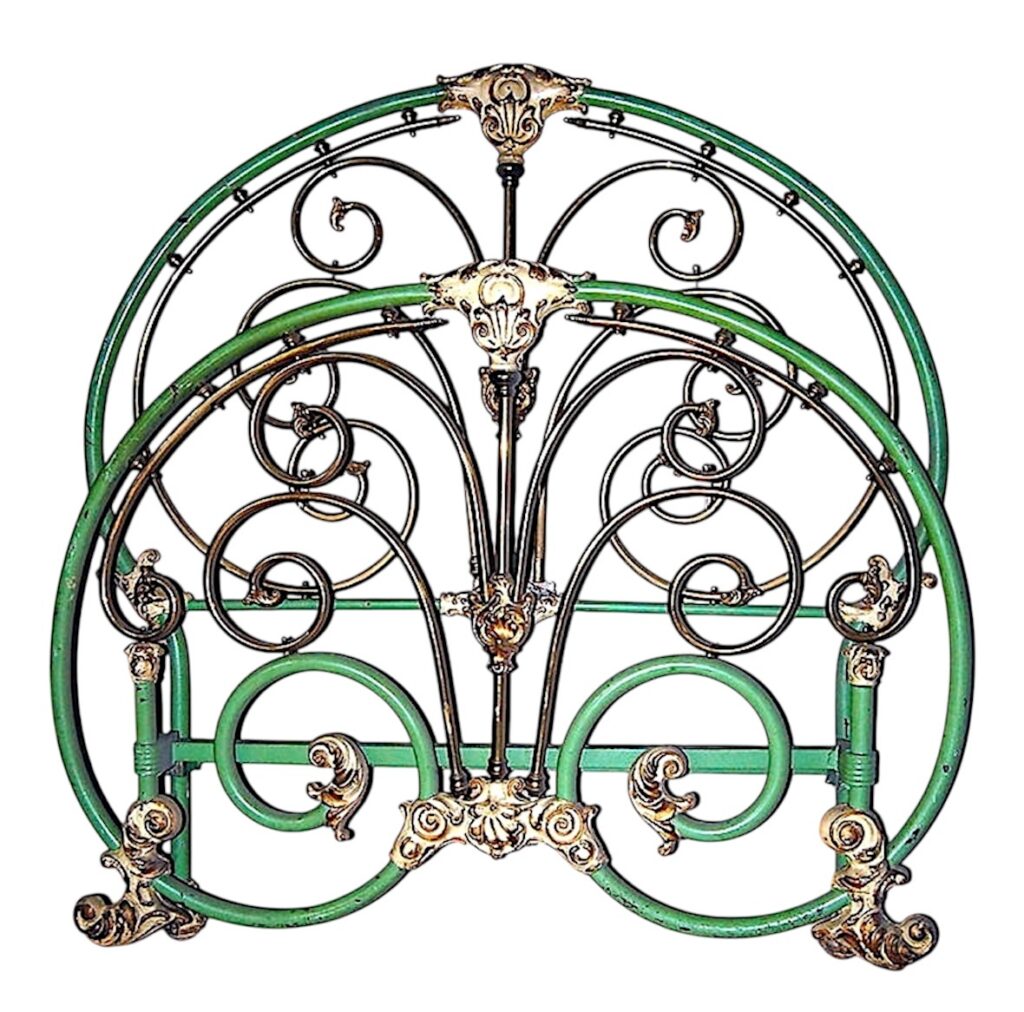 Metal bedsteads began becoming commercially important during the first half of the 19th century, particularly in Britain, with American manufacturers following.
The earliest iron beds tended to be relatively straightforward.
That makes sense.
The first job of an iron bed was to prove that it worked.
It needed to support a mattress.
It needed reliable side rails and connections.
It needed to be durable.
And one of its great selling points was cleanliness. Unlike complicated wooden bedsteads with joints and crevices that could harbor insects, iron could be cleaned much more easily.
But once the practical iron bed had established itself, manufacturers faced another challenge:
How do we make it beautiful?
And scrolling provided one of the answers.
The Victorian Era Was the Perfect Storm
Queen Victoria reigned from 1837 until 1901, which happens to overlap almost perfectly with the great development of the decorative iron bed.
Victorian taste generally embraced ornamentation.
Flowers.
Leaves.
Medallions.
Finials.
Castings.
Brass.
And, of course, scrolls.
At the same time, improvements in manufacturing meant manufacturers could combine steel or iron tubing and rods with cast-iron decorative components.
This opened extraordinary possibilities.
Instead of a headboard consisting simply of vertical rods, those rods could curve.
They could cross.
They could form C-scrolls.
Two C-scrolls could oppose one another.
Longer pieces could create sweeping S-scrolls.
And where those pieces intersected, the manufacturer could install a decorative casting.
That combination—scrolling iron plus decorative castings—became one of the signatures of the Victorian antique iron bed.
Was Scrolling More Expensive?
Generally speaking, complexity cost money.
A very inexpensive iron bed could be made largely from straight tubing and rods with relatively simple castings.
The more complicated the design became, the more manufacturing steps were required.
Iron had to be cut.
Curves had to be formed consistently.
Components had to line up correctly.
Castings had to be produced.
Everything then had to be assembled into a symmetrical design.
This is something that is easy to overlook today.
When we see an elaborate antique iron bed, we see the finished design.
The Victorian manufacturer saw labor.
Every additional curve, casting and decorative component represented another manufacturing operation.
That is one reason some of the better antique iron beds have such wonderfully complicated scrolling.
The manufacturer wasn’t trying to produce the cheapest bed possible.
He was trying to produce a bed that would attract attention in the showroom.
Scrolling Also Solved a Design Problem
There’s another reason I think scrolling worked so beautifully on iron beds.
A headboard is basically a large empty rectangle.
Fill that rectangle entirely with straight vertical rods and the bed can begin to look like a fence.
Scrolling breaks that rigidity.
It moves the eye.
A curve can lead your eye toward a central casting.
Two opposing scrolls create symmetry.
An S-curve introduces movement.
A large sweeping scroll can fill considerable visual space without making the bed look heavy or solid.
That became one of iron’s great advantages over wood.
An iron bed could be highly decorative while remaining visually open.
You could literally see the wall, wallpaper and bedding through the design.
For Victorian designers, that was an extraordinary canvas.
From Victorian Scrolls to Art Nouveau
Toward the end of the 19th century, scrolling took another interesting turn.
Art Nouveau emerged during the 1890s and early 1900s with an even greater fascination with flowing natural forms.
Lines became longer.
Curves became more fluid.
Flowers, stems and vines seemed almost to grow through the design.
When you look at certain late Victorian and Art Nouveau antique iron beds, you can see that transition.
Earlier scrolls can appear formal and symmetrical.
Later examples sometimes become looser, more organic and almost botanical.
Once again, the iron bed was reflecting what was happening in architecture and decorative art around it.
So Who Invented Scrolling?
No one person.
And perhaps that’s the most interesting answer of all.
Scrolling wasn’t invented for furniture.
It wasn’t invented by the Victorians.
And it certainly wasn’t invented by an iron-bed manufacturer.
It was a decorative language developed and refined over thousands of years.
Ancient craftsmen studied plants, vines and spirals.
Greek and Roman designers transformed them into architectural ornament.
Medieval craftsmen preserved and adapted them.
Renaissance designers rediscovered classical forms.
Baroque artists exaggerated them.
Blacksmiths learned to create them in iron.
And finally, 19th-century iron-bed manufacturers realized that this ancient decorative vocabulary was almost perfectly suited to their new product.
Thousands of Years of Design—Beside Your Pillow
That’s what I find fascinating about original antique iron beds.
They aren’t isolated pieces of furniture.
They’re little pieces of architectural and decorative history.
The next time you look at an antique iron bed with a beautiful pair of sweeping scrolls, look beyond the bed itself.
That curve has ancestors.
Its design can be traced backward through Victorian foundries, European ironworkers, Baroque ornament, Renaissance pattern books and ultimately into the classical world.
The craftsman who bent that piece of iron in Pittsburgh, Chicago, Birmingham or some small unidentified foundry during the 1800s probably wasn’t thinking about ancient Rome while he worked.
He was simply making a beautiful bed.
But without realizing it, he was continuing a decorative tradition that had already survived for thousands of years.
And more than a century later, those scrolls are still doing exactly what they were intended to do.
Turning a functional piece of iron into something beautiful.