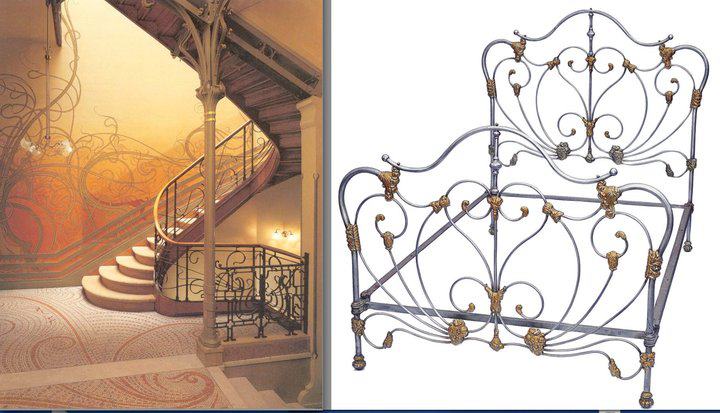
When people begin their search for antiq
ue iron beds, they’re often surprised by the incredible dive
rsity of styles that emerged across different design eras. At CathouseBeds.com, where we specialize exclusively in genuine period-era antique iron beds, we see every day how dramatically one design movement can differ from the ne
xt. Among all historical styles, one remains especially captivating for collectors, decorators, and those who appreciate romantic, organic beauty: the Art Nouveau antique iron bed.
Art Nouveau represents a moment in design history when artists broke from tradition and embraced natural forms, flowing lines, and a sense of movement rarely seen in furniture before or since. But to fully appreciate the uniqueness of an Art Nouveau iron bed, it helps to understand how it compares to the other dominant design eras of antique iron beds—most notably the Victorian, Art Deco, and Craftsman movements.
What follows is a detailed exploration of how Art Nouveau stands apart, what defines the style in iron furniture, a
nd how it fits into the broader evolution of antique bed design.
The Rise of Art Nouveau: A Brief Overview
Art Nouveau flourished from the late 1880s through the early 1910s, overlapping the end of the Victorian period and coming just before the modernist styles that would define the 1920s. The movement took shape as an international response to industrialization. Artists wanted to revive craftsmanship and nature-inspired forms rather than rely on heavy, mechanical ornamentation.
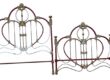
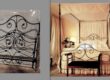
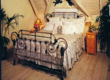
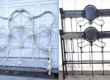
In furniture—especially antique iron beds—Art Nouveau is immediately recognizable. The lines are fluid, the shapes asymmetrical, and the forms often mimic vines, buds, flowers, stems, waves, and other organic patterns. A genuine Art Nouveau antique iron bed feels almost alive, as though the metal has grown rather than been forged.
This is the heart of what separates Art Nouveau from the other major periods.
How Art Nouveau Differs from the Victorian Style
The Victorian era (roughly 1837–1901) dominates the landscape of antique iron beds, simply because it lasted so long and produced a vast number of designs. Victorian iron beds tend to be ornate, but their ornamentation is rooted in symmetry and formality.
Key Victorian Traits
-
Heavy, symmetrical scrollwork
-
Repeating geometric or botanical motifs
-
Strong influence from Gothic, Rococo, and Renaissance revival styles
-
A tendency toward vertical emphasis and grand, formal flourishes
Victorian beds are often richly detailed, but the detail is organized, predictable, and balanced. A Victorian antique iron bed expresses elegance through order and ornamental density.
How Art Nouveau Stands Apart
Where Victorian design is structured, Art Nouveau is untamed. Instead of symmetrical scrolls, Art Nouveau beds feature whiplash curves—those loose, flowing lines that sweep like tendrils of smoke or curling vines. Instead of repeated patterns, Art Nouveau emphasizes movement and asymmetry. Some of the most striking Art Nouveau antique iron beds seem to stretch or sway, capturing the sense of growth found in nature.
In short:
-
Victorian = formal, symmetrical, ornate
-
Art Nouveau = organic, flowing, asymmetrical
Collectors often choose an Art Nouveau bed when they desire something softer, more artistic, and less rigid than a Victorian frame. While both are beautiful, their energies couldn’t be more different.
Art Nouveau vs. Art Deco: Nature vs. Modernity
Just as Art Nouveau reached its peak, the world moved steadily toward the streamlined, geometric style of the Art Deco period. Emerging in the 1910s and dominating the 1920s and 1930s, Art Deco reflected the new machine age, modernity, and industrial progress. The contrast with Art Nouveau could not be clearer.
Key Art Deco Traits
-
Bold geometric shapes
-
Strong vertical lines and stepped forms
-
Symmetry with a modern edge
-
Sleek, polished surfaces and minimal curves
-
Influence of skyscrapers, automobiles, and industrial design
An Art Deco antique iron bed feels modern even today. Its lines are crisp, its structure bold, and its aesthetic more architectural than natural.
How Art Nouveau Differs
Where Art Deco embraces man-made geometry, Art Nouveau celebrates organic naturalism.
Where Art Deco is sharp, Art Nouveau is soft.
Where Deco is structured, Nouveau is free-flowing.
If Art Deco looks forward to the machine age, Art Nouveau looks back to nature as the ultimate inspiration.
Collectors attracted to the sensual, romantic curves of an Art Nouveau antique iron bed rarely find the same warmth in the crisp geometry of Art Deco. The two styles appeal to entirely different sensibilities—even though the periods sit almost back-to-back in design history.
Art Nouveau vs. Craftsman Style: Curves vs. Simplicity
The Craftsman or Arts and Crafts movement also overlapped with the Art Nouveau era, though it emerged earlier, in the late 1860s and 1870s. Craftsman design grew partly from the same dissatisfaction with industrial mass production that gave birth to Art Nouveau, but the solution it presented was very different.
Key Craftsman Traits
-
Simplicity and honesty of form
-
Straight, sturdy lines
-
Minimal ornamentation
-
Emphasis on craftsmanship and natural materials
-
A preference for wood over metal
While the Craftsman movement rarely produced ornate iron beds, the few Craftsman-style antiq
ue iron beds that do exist follow the same principles: clean lines, structural emphasis, and little to no embellishment. They feel steady, grounded, and humble.
How Art Nouveau Contrasts
Even though both movements value artisanship, Art Nouveau revives decoration and emotional expression. Compared to the severe simplicity of Craftsman forms, Art Nouveau beds appear:
-
More decorative
-
More romantic
-
More whimsical
-
More fluid and expressive
Craftsman designs promote stability and authenticity. Art Nouveau promotes grace, movement, and visual poetry.
Distinguishing Features of Art Nouveau Antique Iron Beds
For collectors browsing antique iron beds, the challenge is often identifying the period of a particular piece. Art Nouveau iron beds display several unmistakable hallmarks:
1. Whiplash Curves
This is the most iconic Art Nouveau feature—long, flowing lines that twist like vines or waves. These curves are rar
ely symmetrical and often stretch across the entire headboard or footboard.
2. Nature-Inspired Themes
Florals, buds, leaves, and tendrils dominate Art Nouveau motifs. Many frames seem to grow rather than stand.
3. Organic Asymmetry
Unlike the predictable mirror-image balance of Victorian beds, Art Nouveau beds may have one side different from the other, creating a dynamic sense of movement.
4. Negative Space
Art Nouveau designers used open areas within the frame to highlight the beauty of the curves, giving the silhouette a light, airy aesthetic.
5. Graceful Vertical Lines
While Victorian beds are often vertically imposing, Art Nouveau lines stretch or bend in softer, more graceful ways.
These traits make the Art Nouveau antique iron bed one of the most visually striking styles ever produced.
Why Art Nouveau Antique Iron Beds Appeal to Modern Collectors
Despite being over a century old, Art Nouveau designs blend remarkably well with today’s interiors. Modern decorators appreciate them because:
-
They pair beautifully with contemporary minimalism
-
Their organic lines soften modern edges
-
They complement natural materials like linen, jute, wood, and stone
-
Their sculptural form makes them a focal point in any room
-
They offer a sense of romance and artistry rarely found in modern furniture
Whether placed in a historic home, a modern apartment, or a transitional interior, an Art Nouveau antique iron bed brings character, craftsmanship, and unmistakable charm.
How Art Nouveau Fits into the Broader Antique Iron Bed Market
As a specialty retailer, CathouseBeds.com sees every style evolve in popularity over time. Victorian iron beds have long been the most common in the marketplace. Art Deco beds spike in interest among collectors who love early modern design. Craftsman beds serve customers who prefer simplicity and clean lines.
But Art Nouveau iron beds remain consistently in demand because they bridge the gap between vintage charm and modern elegance. Their scarcity also adds to their desirability—true period Art Nouveau pieces are far less common than Victorian or early-twentieth-century styles.
Collectors who want something rare, expressive, and sculptural often fall in love with Art Nouveau beds instantly.
Choosing the Right Antique Iron Bed for Your Home
When selecting an antique iron bed, consider:
Your home’s architectural style
-
Victorian homes pair beautifully with Victorian or Art Nouveau pieces.
-
Craftsman homes lean toward simpler frames.
-
Modern homes can be transformed by the flowing lines of an Art Nouveau bed or the geometry of Art Deco.
Your personal aesthetic
Do you prefer structure (Victorian or Art Deco) or movement (Art Nouveau)? Do you want simplicity (Craftsman) or expressive detail (Victorian and Art Nouveau)?
Rarity and craftsmanship
Art Nouveau beds are often artisan-made, with hand-formed curves that make each piece unique.
At CathouseBeds.com, every bed is restored with respect for its original design era, ensuring that your antique iron bed retains the authenticity and grace that have kept these pieces beloved for more than a century.
Conclusion: Art Nouveau’s Enduring Magic
Among the many stylistic periods that define antique iron beds, Art Nouveau remains one of the most romantic, artistic, and unforgettable. Its flowing lines, nature-inspired themes, and expressive forms set it apart not only from the structured elegance of the Victorian era, but also from the sleek geometry of Art Deco and the honest simplicity of Craftsman design.
For collectors and homeowners seeking a bed that functions as a sculpture, a conversation piece, and a timeless piece of artistry, an Art Nouveau
antique iron bed offers something no other period can match.
At CathouseBeds.com, we proudly specialize in bringing these historic treasures back to life. Whether you’re searching for the perfect Art Nouveau piece or exploring designs from other eras, we’re here to help you find the antique iron bed that speaks to your style, your home, and your love of history.