
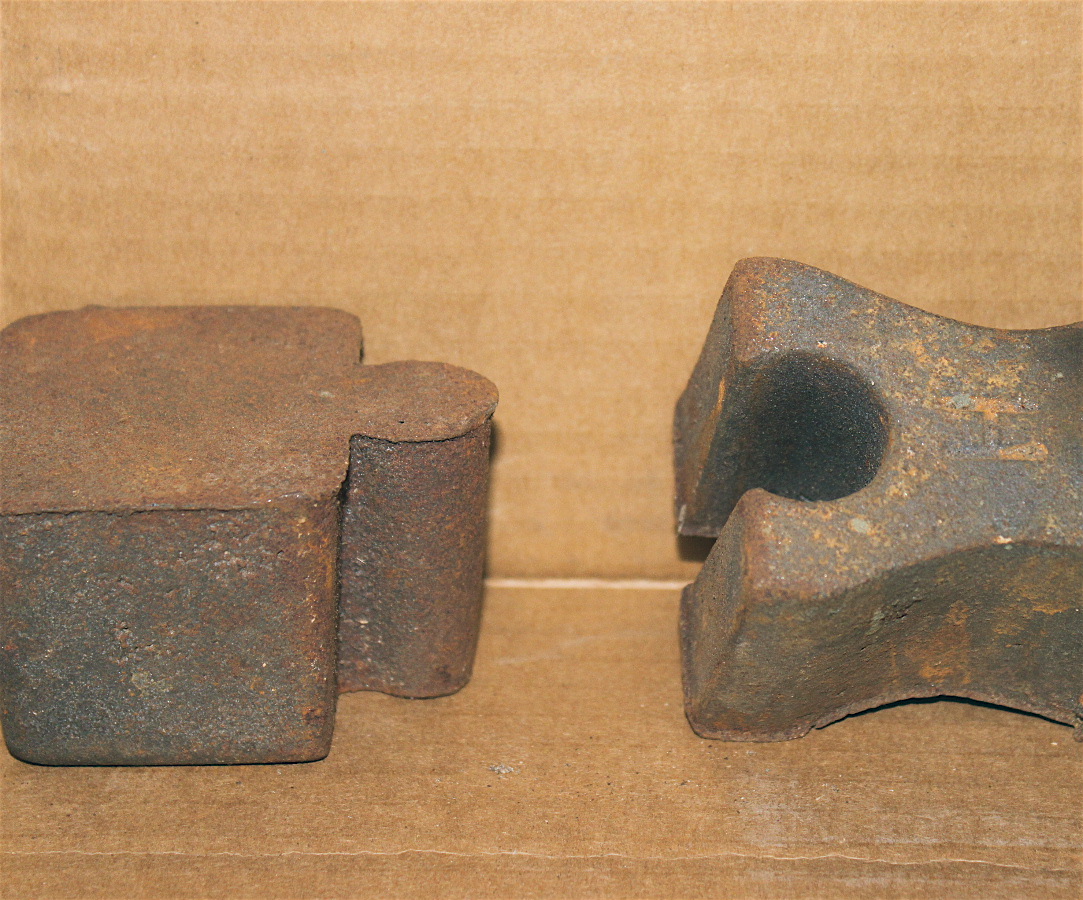
Assembling an antique bed is a simple process……..but be careful. There are no screws or bolts needed to assemble your bed. The side rails, that connect the headboard to the footboard, fit in a simple “drop in” method. The mistake people make is in using a hammer to pound the rails down in to the “hitch” of the head and footboard. The end of the siderail has a cast iron “conical” shape that was poured on the end of the rail, when the bed was made in the 1800′s. This conical end fit’s into an “opposite” shape that was also poured on the head and footboard when the bed was constructed. It’s important to NOT try and pound the siderail into the “hitches” with a hammer. Although still around for nearly 200 years, these beds should be treated with the same care anything of this age should be cared for.
There is a thing called “harmonic concussion”. This is when a newly made cast iron hammer head hit’s a much older piece of cast iron who’s molecular content has altered and become more brittle. To eliminate the possibility of this “harmonic concussion” occurring on your
bed, use a rubber mallet or a piece of wood.
Keep in mind…….it’s not always necessary for the side rail on your iron bed to be flush with the top of the hitch….just secure.
I hope you’ve found this blog informative . I invite you to revisit my website
to answer any and all questions you might have about antique iron beds.
I also invite you to take a look at our company Face Book page for multiple photo albums on Custom Finishes, Canopy Conversions and a comprehensive “Before & After” King Conversions album.


Glad our assembly post was helpful. Always happy to help if you get yourself in the middle of putting your bed together and something doesn’t seem right. Just give us a shout 310-457-1106. Craig
The cause of most head and footboard movement is an incorrect set of siderails. It is a common belief that all side rails are inter-changeable. WRONG…….All of the individual foundries, and their were literally thousands of them, had their own “hitch” molds which the side rail fit down into. Unfortunately the tapper and conical shape of the end of the side rails look very similar, leading most people to think they should work. Not So.
There are two things you can do………if the side rail doesn’t fit all the way down into the hitch, you could have someone use a hand held grinding wheel to subtly grind down the over-sized section. This has to be done very carefully……..if too much is ground away, it will exacerbate the degree of movement you already have. The other fix, if you find a slight space between the end of the side rail and the face of the hitch, is to have a welder put the siderail in one of the hitches and see how much a little “spot weld” could be put on the face of the side rail end, to fill in that gap. A little grinding on the “spot weld” might be necessary to get a snug fit. If you need help…..give me a call, I’ll walk you through it. 310-457-1106 – Craig
50% of the companies that made iron or brass beds back in the 1800′s made their side rails so they fit in with a flat top…not an “L” shape. The ones that made their side rails so they had an “L” shape, are ones we can easily have wooden 2″ x 4″ bed slats cut to fit inside and go the width of the bed. Four slats are plenty. Your box spring will set right on top of those 2″ x 4″s……..the box spring NEVER set inside the “L” shape of the rail.
If your side rails are flat top then you’ll be doing the same thing except the 2″ x 4″s will go under the side rails and into the upside down “L” shape. You will have to drill a 1/4″ hole through the top of the siderail and also through the wooden 2″ x 4″. Secure the 2″ x 4″ under the siderail with a 2 1/2″ pan head bolt and nut with washer that will go through the top of the siderail and then through the wooden bed slat. Your box spring will then set right on top of the siderail and the wooden slats will prevent it from falling off.
Hope this has helped.